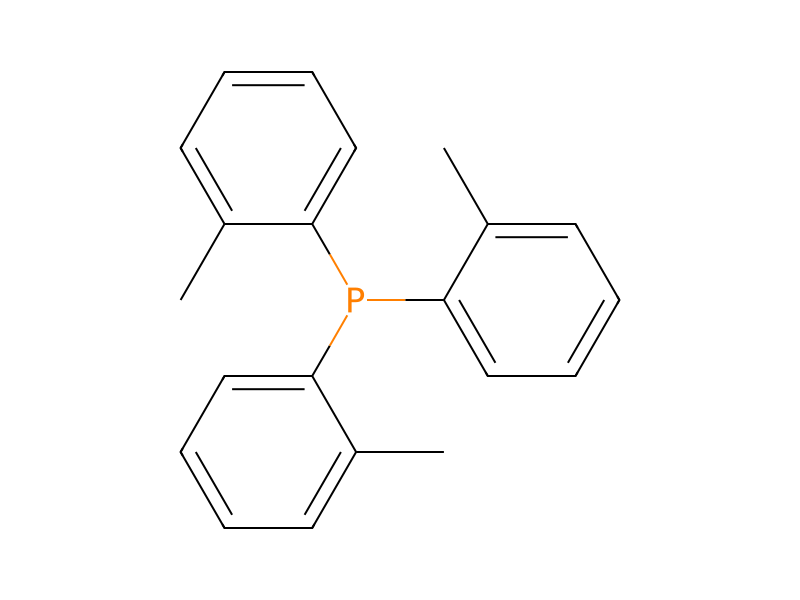
Tri-o-tolylphosphine → HCID 16212642, compound
Reaction equation

C([O-])(=O)C.[K+].[CH3:6][CH2:7][C:8]([CH2:29][O:30]CCCOC(C=C)=O)([CH2:19][O:20]CCCOC(C=C)=O)[CH2:9][O:10]CCCOC(C=C)=O.C1(C)C=CC=CC=1P(C1C=CC=CC=1C)C1C=CC=CC=1C.BrC1C2CCC=2C=CC=1>CN(C)C=O.C([O-])(=O)C.[Pd+2].C([O-])(=O)C.C1(C)C=CC=CC=1.O>[CH3:6][CH2:7][C:8]([CH2:29][OH:30])([CH2:19][OH:20])[CH2:9][OH:10].[CH2:8]([CH2:19][OH:20])[CH2:9][OH:10]Participants
Reactant 4



Product 1

Reagents, catalysts & solvents 4




Conditions
- Temperature
- 80 °C
Procedure
A 2000 mL three-necked, round bottomed flask with bottom drain port, outfitted with a mechanical stirrer, pressure equalizing addition funnel and condenser with attached nitrogen inlet was charged with potassium acetate (125.6 g, 1.28 mol) and deionized (DI) water (60 mL). The solution was stirred for 10 min. and then trimethylolpropane propoxylate triacrylate having an average of 2 propoxylate groups (107.1 g, 165.9 mmol), 100 mL dimethylformamide (DMF), palladium acetate (0.27 g, 1.18 mmol) and tri(o-tolyl)phosphine (1.14 g, 3.75 mmol) were added to the vessel and the mixture was sparged with nitrogen with stirring for 30 min. The pressure equalizing addition funnel was charged with a solution of 3-bromobenzocyclobutane (91.46 g, 499.6 mmol) in DMF (50 mL). This solution was then de-gassed via nitrogen sparge for 20 min. The reaction solution was slowly heated to 80° C. followed by slow addition of the 3-bromobenzocyclobutane. Reaction completeness was monitored by the disappearance of 3-bromobenzocyclobutane via gas chromatography, which took 27 hr. Toluene (200 mL) was added to the solution which was then cooled to room temperature. The aqueous layer, which was laden with suspended solids, was removed via the reactor bottom drain. The organic layer was filtered over a pad of celite via vacuum filtration. The filtrate was washed with deionized water, resulting in an emulsion which would not separate. The emulsion was filtered again through celite to separate the organic and aqueous layers. The organic layer was isolated, dried over anhydrous magnesium sulfate, filtered and condensed to afford the product as a clear yellow colored viscous oil. Yield: 140.4 g (88.9%).
Workup
- customA 2000 mL three-necked, round bottomed flask with bottom drain port, outfitted with a mechanical stirrer
- additionaddition funnel and condenser with attached nitrogen inlet
- customthe mixture was sparged with nitrogen
- stirringwith stirring for 30 min
- additionaddition funnel
- customThis solution was then de-gassed via nitrogen
- customsparge for 20 min
- additionfollowed by slow addition of the 3-bromobenzocyclobutane
- customReaction completeness
- waittook 27 hr
- temperaturewas then cooled to room temperature
- customwas removed via the reactor bottom drain
- filtrationThe organic layer was filtered over a pad of celite via vacuum filtration
- washThe filtrate was washed with deionized water
- customresulting in an emulsion which would not
- customseparate
- filtrationThe emulsion was filtered again through celite
- customto separate the organic and aqueous layers
- customThe organic layer was isolated
- dry with materialdried over anhydrous magnesium sulfate
- filtrationfiltered
- customcondensed
Sources & evidence
- ORD record
- ord-f1262a14857e4629b9a9730a6eba265e
- Source dataset
- uspto-grants-2016_09
- Patent number
- US09441055B1
Reaction notes
Loading…