Tributylamine → Vinyl Acetate
Reaction equation

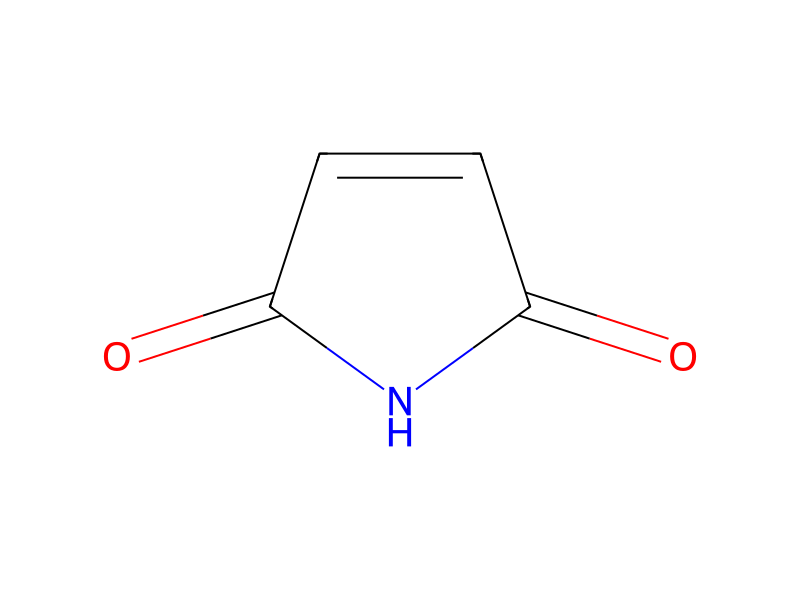
[C:1]1(=[O:7])[NH:5][C:4](=[O:6])[CH:3]=[CH:2]1.[C:8]([O:11][CH:12]=[CH2:13])(=[O:10])[CH3:9].C(N(CCCC)CCCC)CCC>>[C:4]1(=[O:6])[NH:5][C:1](=[O:7])[CH:2]=[CH:3]1.[C:8]([O:11][CH:12]=[CH2:13])(=[O:10])[CH3:9]Participants


Procedure
One half gram of maleimide/vinyl acetate copolymer (theoretical composition: 52.4% carbon; 4.91% hydrogen; 7.65% nitrogen; 35.0% oxygen) was dissolved in 6 mls. of purified tri-n-butylamine and the solution heated at 170° C. for 8 hours under nitrogen. The tri-n-butylamine was stripped off under vacuum and the remaining blue-gray solid was extracted with hexane and dried. The product is soluble in formamide, dimethyl sulfoxide, or hot γ-butyrolactone, and is partially soluble in pyridine. The color of the blue-gray solid is bleached to a light pink when treated with aqueous hydrochloric acid. Aqueous sodium hydroxide restores the color. Elemental analysis of the blue-gray solid showed 55.88% carbon; 5.43% hydrogen; 10.04% nitrogen and 28.65% oxygen by difference. The theoretical elemental composition of the product resulting from the complete removal of acetic acid from a 1/1 copolymer of maleimide and vinyl acetate is 58.50% carbon; 4.06% hydrogen; 11.40% nitrogen and 26.04% oxygen. Comparison of the carbonyl stretching at 1770 cm-1 in the infrared spectra of the maleimide/vinyl acetate copolymer and the blue-gray product obtained from treatment with tri-n-butylamine indicates that the maleimide ring remains intact. The large decrease in the intensity of the --C--O-- stretching vibration of the acetate group (1230 cm-1) indicates elimination of the acetate group, but it does not appear as though acetic acid is stripped out quantitatively.
Workup
- extractionthe remaining blue-gray solid was extracted with hexane
- customdried
- additiontreated with aqueous hydrochloric acid
Sources & evidence
- ORD record
- ord-f470e8b038df49b19a8dc6947c155f51
- Source dataset
- uspto-grants-1979_03
- Patent number
- US04144063
Reaction notes
Loading…