3-Furanol, tetrahydro- → 3-[(2-Fluorophenyl)methoxy]oxolane
Reaction equation

[OH:1][CH:2]1[CH2:6][CH2:5][O:4][CH2:3]1.[H-].[Na+].[F:9][C:10]1[CH:17]=[CH:16][CH:15]=[CH:14][C:11]=1[CH2:12]Br.[Na]>O1CCOCC1.CO>[F:9][C:10]1[CH:17]=[CH:16][CH:15]=[CH:14][C:11]=1[CH2:12][O:1][CH:2]1[CH2:6][CH2:5][O:4][CH2:3]1Participants
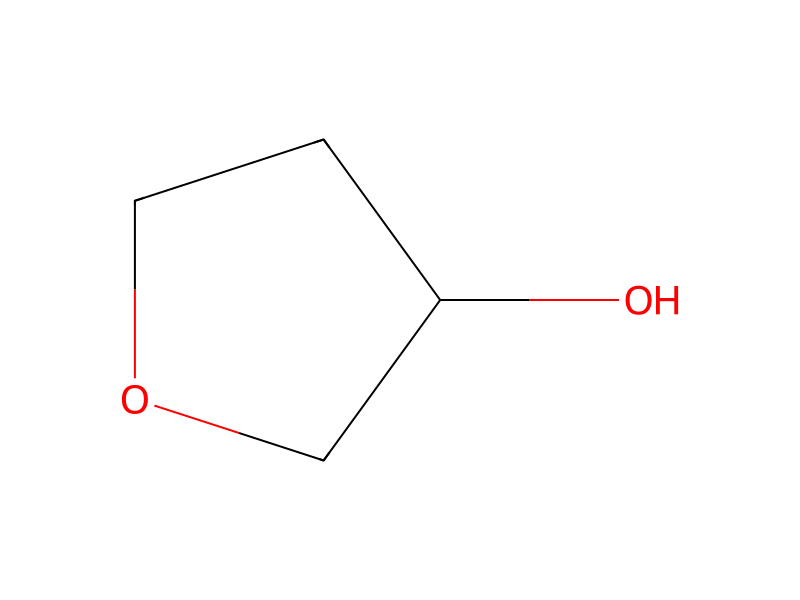






Conditions
- Temperature
- 50 °C
Procedure
8.8 g (0.1 mole) of 3-hydroxy-tetrahydrofurane were added dropwise, whilst stirring, to a mixture of 2.8 g (0.12 mole) of sodium hydride (3.5 g of 80% strength sodium hydride in paraffin oil) in 100 ml of absolute dioxan at room temperature. The mixture was then heated for 30 minutes under reflux. After cooling to 50° C., 19 g (0.1 mol) of 2-fluorobenzyl bromide were added dropwise to the sodium salt thus obtained. The mixture was then heated for 3 hours under reflux and was allowed to cool to room temperature, 10 ml of methanol were added to destroy the excess sodium hydride, and the mixture was concentrated by distilling off the solvent in vacuo. The residue was taken up in 100 ml of water and extracted with methylene chloride. The organic phase was dried over sodium sulphate and concentrated. The residue was distilled in vacuo. 15.7 g (80% of theory) of 3-(2-fluorobenzyloxy)-tetrahydrofurane of boiling point 89° C./0.1 mm Hg were obtained.
Workup
- temperatureThe mixture was then heated for 30 minutes
- temperatureunder reflux
- customthus obtained
- temperatureThe mixture was then heated for 3 hours
- temperatureunder reflux
- temperatureto cool to room temperature
- customto destroy the excess sodium hydride
- concentrationthe mixture was concentrated
- distillationby distilling off the solvent in vacuo
- extractionextracted with methylene chloride
- dry with materialThe organic phase was dried over sodium sulphate
- concentrationconcentrated
- distillationThe residue was distilled in vacuo
Sources & evidence
- ORD record
- ord-2a65735bcd7b470eb4cf9e43032b2629
- Source dataset
- uspto-grants-1979_03
- Patent number
- US04146384
Reaction notes
Loading…