Tetrahydrofuran → HCID 22118572, compound
Reaction equation

[NH2:1][C:2]1[S:3][C:4]([F:14])=[C:5](/[C:7](=[N:12]/[OH:13])/[C:8]([O:10]C)=[O:9])[N:6]=1.B(Cl)(Cl)Cl.O1CCCC1.C(=O)(O)[O-].[Na+]>ClCCl.[Cl-].[Na+].O>[NH2:1][C:2]1[S:3][C:4]([F:14])=[C:5](/[C:7](=[N:12]/[OH:13])/[C:8]([OH:10])=[O:9])[N:6]=1Participants
Reactant 4



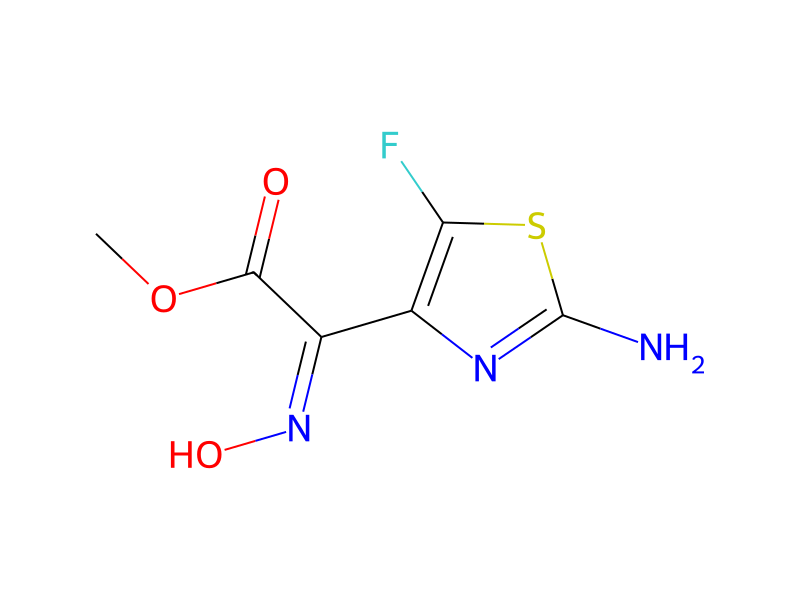
Product 1

Reagents, catalysts & solvents 2


Procedure
To a suspension of methyl 2-(2-amino-5-fluorothiazol-4-yl)-2-(Z)-(hydroxyimino)acetate (1 g) in dichloromethane (20 ml) was added dropwise 1M borontrichloride solution in dichloromethane (22.8 ml) under ice-cooling with stirring, and the mixture was stirred for 3 hours at 50° C. to 10° C. The resulting solution was poured into a mixture of tetrahydrofuran (30 ml) and brine (15 ml), and adjusted to pH 3.0 with saturated aqueous sodium bicarbonate. The separated organic phase was dried with magnesium sulfate and evaporated in vacuo. The residue was subjected to a column chromatography on silica gel and eluted with a mixture of ethyl acetate and methanol (2:1). The fractions containing the object compound were combined and evaporated in vacuo to give 2-(2-amino-5-fluorothiazol-4-yl)-2-(Z)-(hydroxyimino)acetic acid (330.26 mg).
Workup
- temperaturecooling
- stirringthe mixture was stirred for 3 hours at 50° C. to 10° C
- dry with materialThe separated organic phase was dried with magnesium sulfate
- customevaporated in vacuo
- washeluted with a mixture of ethyl acetate and methanol (2:1)
- additionThe fractions containing the object compound
- customevaporated in vacuo
Sources & evidence
- ORD record
- ord-aba858d9d5794ac3ba120288936d3e58
- Source dataset
- uspto-grants-1999_09
- Patent number
- US05958914
Reaction notes
Loading…