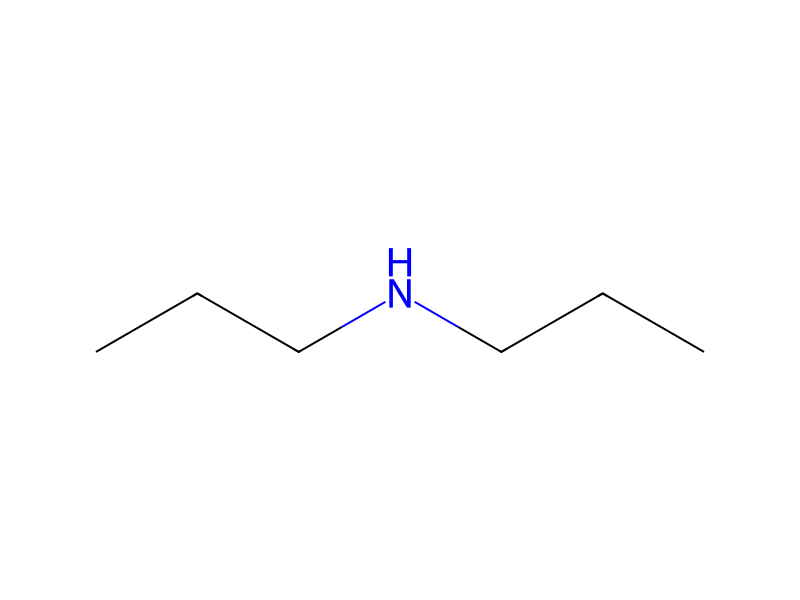
Dipropylamine → HCID 14390344, compound
Reaction equation

[Cl:1][C:2]1[CH:7]=[CH:6][C:5]([C:8]2[N:16]([CH2:17][CH2:18][C:19]([OH:21])=O)[C:11]3=[N:12][CH:13]=[CH:14][CH:15]=[C:10]3[N:9]=2)=[CH:4][CH:3]=1.C(N1C=CN=C1)(N1C=CN=C1)=O.[CH2:34]([NH:37][CH2:38][CH2:39][CH3:40])[CH2:35][CH3:36]>O1CCCC1>[Cl:1][C:2]1[CH:7]=[CH:6][C:5]([C:8]2[N:16]([CH2:17][CH2:18][C:19]([N:37]([CH2:38][CH2:39][CH3:40])[CH2:34][CH2:35][CH3:36])=[O:21])[C:11]3=[N:12][CH:13]=[CH:14][CH:15]=[C:10]3[N:9]=2)=[CH:4][CH:3]=1Participants
Reactant 3


Product 1

Reagents, catalysts & solvents 1

Procedure
A suspension of 2-(4-chlorophenyl)-3H-imidazo[4,5-b]pyridine-3-propanoic acid (5.0 g, 0.0166 mole), 1,1'-carbonyldiimidazole (3.21 g, 0.0198 mole) and dry tetrahydrofuran (100 ml) was stirred at room temperature for 1 hour with nitrogen bubbling through it. The reaction mixture was then heated at reflux for 1 hour under nitrogen during which a solution formed. A solution of dipropylamine (5.04 g, 0.050 mole) in tetrahydrofuran (7 ml) was added and the reaction mixture was heated at 50° C. overnight under nitrogen. The reaction mixture was evaporated under reduced pressure and the residue was partitioned between water and ethyl acetate (100 ml of each). The two layer mixture was filtered to remove an insoluble solid and the layers were separated. The aqueous layer was re-extracted once with ethyl acetate and the combined organic layers were washed once with a 5% potassium hydroxide solution (100 ml), dried over sodium sulfate, filtered, and evaporated to a residue weighing 8.9 g. The residue was dissolved in hot isopropyl alcohol, filtered, cooled to room temperature, and water was added. Solid formed which was collected by filtration to give 4.84 g (76%) of a white solid, after drying under vacuum overnight, mp 104°-105.5° C.
Workup
- temperatureThe reaction mixture was then heated
- temperatureat reflux for 1 hour under nitrogen during which a solution
- customformed
- temperaturethe reaction mixture was heated at 50° C. overnight under nitrogen
- customThe reaction mixture was evaporated under reduced pressure
- customthe residue was partitioned between water and ethyl acetate (100 ml of each)
- filtrationThe two layer mixture was filtered
- customto remove an insoluble solid
- customthe layers were separated
- extractionThe aqueous layer was re-extracted once with ethyl acetate
- washthe combined organic layers were washed once with a 5% potassium hydroxide solution (100 ml)
- dry with materialdried over sodium sulfate
- filtrationfiltered
- customevaporated to a residue
- dissolutionThe residue was dissolved in hot isopropyl alcohol
- filtrationfiltered
- temperaturecooled to room temperature
- additionwater was added
- customSolid formed which
- filtrationwas collected by filtration
Sources & evidence
- ORD record
- ord-39f091e450b94763b4684e67e8685969
- Source dataset
- uspto-grants-1989_04
- Patent number
- US04824951
Reaction notes
Loading…