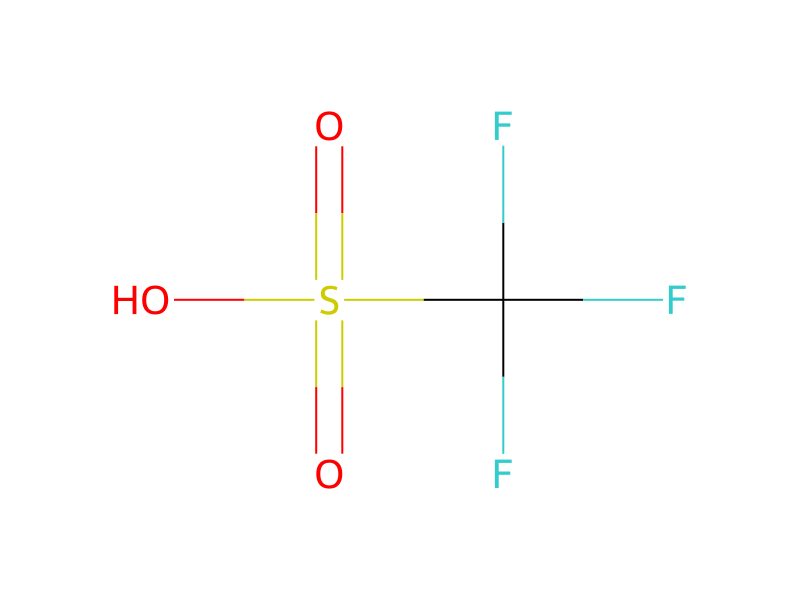
Trifluoromethanesulfonic acid → Fluoren-1-amine
Reaction equation

CC(C)=C1C(C2C=CC(OCC(O)CO)=CC=2)C=CC=C1.C[C@@:23]1(O)[C:38]2C=CC=C(O)[C:37]=2[C:36](O)=[C:35]2[CH:24]1C[CH:26]1[C@:32](O)([C:33]2=O)[C:31](O)=[C:30](C(N)=O)[C:28](=O)[CH:27]1[N:50](C)C.Cl.CC1C=C(C2(C3C=CC(N)=C(C)C=3)C3C=CC=CC=3C3C2=CC=CC=3)C=CC=1N.OS(C(F)(F)F)(=O)=O.C(C1NC=C(C)N=1)C>>[C:27]1([NH2:50])[C:26]2[CH2:36][C:35]3[C:33](=[CH:37][CH:38]=[CH:23][CH:24]=3)[C:32]=2[CH:31]=[CH:30][CH:28]=1Participants


Procedure
An adhesive of the present invention was made by mixing together 25 parts of PKHS, a phenoxy resin from the Union Carbide Corporation, 52 parts of Quatrex 1010, a diglycidyl ether of bisphenol A epoxy resin from the Dow Chemical Company, and 23 parts of 9,9-bis(3-methyl-4-aminophenyl)fluorene (hereinafter BAFOT). These three constituents were stirred to a uniform paste, using methyl ether ketone (MEK) as a solvent for the solution of the phenoxy and epoxy resins, followed by blending in the relatively insoluble BAFOT, and dilution of the resultant paste to 50% solids by weight with additional MEK. The fluorene-amine curative was prepared for dispersion in this epoxy resin system by jet milling to a mean particle size of <5 um. To this dispersion an accelerator, the triflic acid half salt of 2-ethyl-4-methylimidazole was added at a rate of 4 parts per hundred of the solids in the dispersion.
Workup
- additionby mixing together 25 parts of PKHS
Sources & evidence
- ORD record
- ord-c267c7146f2f4f0d916ebecedb9c3dda
- Source dataset
- uspto-grants-1988_09
- Patent number
- US04769399
Reaction notes
Loading…