Triphenylphosphine → Ethyl 1-{[(5-bromo-4-methylpyridin-2-yl)oxy]methyl}cyclobutanecarboxylate
Reaction equation

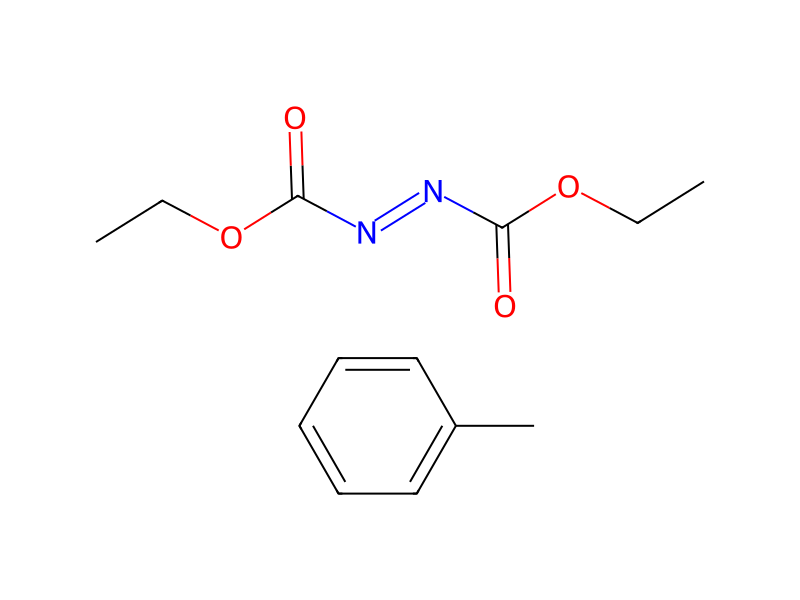
[Br:1][C:2]1[C:3]([CH3:9])=[CH:4][C:5]([OH:8])=[N:6][CH:7]=1.O[CH2:11][C:12]1([C:16]([O:18][CH2:19][CH3:20])=[O:17])[CH2:15][CH2:14][CH2:13]1.C1(P(C2C=CC=CC=2)C2C=CC=CC=2)C=CC=CC=1.N(C(OCC)=O)=NC(OCC)=O.C1(C)C=CC=CC=1>O1CCCC1>[Br:1][C:2]1[C:3]([CH3:9])=[CH:4][C:5]([O:8][CH2:11][C:12]2([C:16]([O:18][CH2:19][CH3:20])=[O:17])[CH2:15][CH2:14][CH2:13]2)=[N:6][CH:7]=1Participants
Reactant 4



Product 1

Reagents, catalysts & solvents 1

Conditions
- Temperature
- 60 °C
Procedure
In tetrahydrofuran (11 mL) were dissolved 5-bromo-4-methylpyridin-2-ol (639 mg), ethyl 1-(hydroxymethyl)cyclobutanecarboxylate (538 mg) and triphenylphosphine (1.07 g), 40% diethyl azodicarboxylate-toluene solution (1.86 mL) was added dropwise to the solution at room temperature, and then, the resulting mixture was stirred at 60° C. for 3 hours. The reaction mixture was cooled to room temperature, concentrated under reduced pressure, and the precipitated solid was removed by filtration. The filtrate was concentrated under reduced pressure, and the obtained residue was purified by silica gel column chromatography (n-hexane:ethyl acetate=100:0 to 90:10) to obtain ethyl 1-{[(5-bromo-4-methylpyridin-2-yl)oxy]methyl}cyclobutanecarboxylate (638 mg).
Workup
- additionwas added dropwise to the solution at room temperature
- temperatureThe reaction mixture was cooled to room temperature
- concentrationconcentrated under reduced pressure
- customthe precipitated solid was removed by filtration
- concentrationThe filtrate was concentrated under reduced pressure
- customthe obtained residue was purified by silica gel column chromatography (n-hexane:ethyl acetate=100:0 to 90:10)
Sources & evidence
- ORD record
- ord-385c5ac363b94a95b1ce93b0e12b09a3
- Source dataset
- uspto-grants-2016_04
- Patent number
- US09302996B2
Reaction notes
Loading…