Aniline → Azidobenzene
Reaction equation

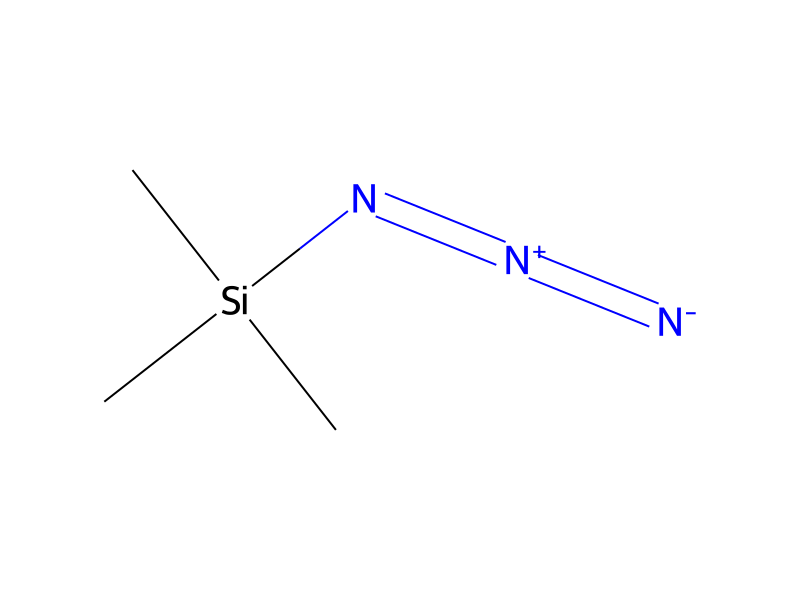
[NH2:1][C:2]1[CH:7]=[CH:6][CH:5]=[CH:4][CH:3]=1.C(#N)C.N(OC(C)(C)C)=O.[Si]([N:22]=[N+:23]=[N-])(C)(C)C>>[N:1]([C:2]1[CH:7]=[CH:6][CH:5]=[CH:4][CH:3]=1)=[N+:22]=[N-:23]Participants
5




Procedure
A solution of aniline (500 mgs, 5.37 mmol) in acetonitrile (10 mL, 191 mmol) was cooled down in an ice bath and treated with tert-butyl nitrite (680 mgs, 6.59 mmol) and dropwise with TMS-N3 (0.713 mL, 5.37 mmol). The ice bath was removed and the mixture was stirred overnight at r.t. under N2. Acetonitrile was carefully evaporated (NB: azidobenzene is also volatile) and the residue (750 mgs) was passed through a silica gel pad (20 g) and eluted with petroleum ether (35-55° C.). Evaporation of the solvent gave the title material as an oil (500 mgs, 4.20 mmol, 78% yield) that still contains some traces of solvent as shown by 1H NMR. 1H NMR (CDCl3, 400 MHz) δ ppm: 7.32-7.41 (m, 2H), 7.12-7.19 (m, 1H), 7.01-7.09 (m, 2H).
Workup
- customThe ice bath was removed
- customAcetonitrile was carefully evaporated (NB
- washeluted with petroleum ether (35-55° C.)
- customEvaporation of the solvent
Sources & evidence
- ORD record
- ord-5fc52bb5f8874b6db304455571ea39dd
- Source dataset
- uspto-grants-2016_04
- Patent number
- US09303065B2
Reaction notes
Loading…