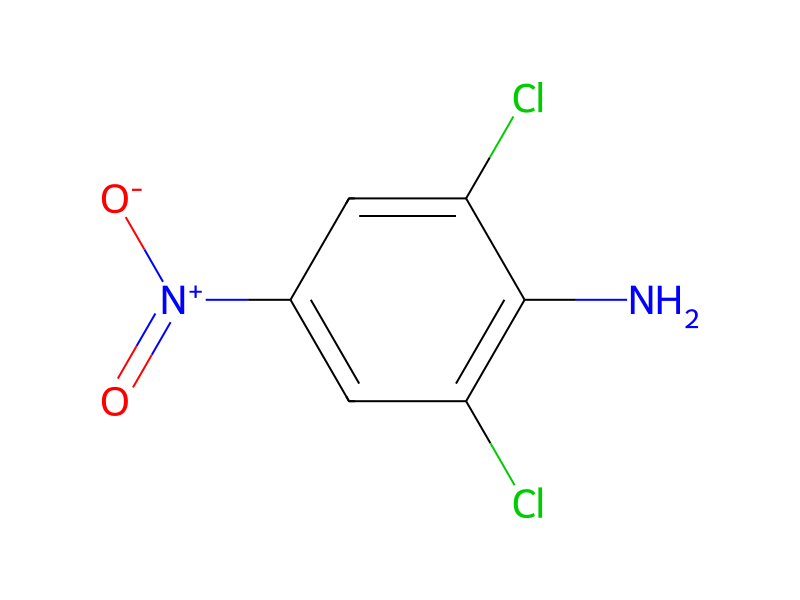
2,6-Dichloro-4-nitroaniline → HCID 178514520, compound
Reaction equation

[N:1]([C:4]1[C:9]([F:10])=[CH:8][N:7]=[CH:6][C:5]=1[CH:11]=O)=[N+:2]=[N-:3].[Cl:13][C:14]1[CH:20]=[C:19]([N+:21]([O-:23])=[O:22])[CH:18]=[C:17]([Cl:24])[C:15]=1[NH2:16].C(N(CC)CC)C>C(Cl)Cl.[Ti](Cl)(Cl)(Cl)Cl>[N:1]([C:4]1[C:9]([F:10])=[CH:8][N:7]=[CH:6][C:5]=1/[CH:11]=[N:16]/[C:15]1[C:17]([Cl:24])=[CH:18][C:19]([N+:21]([O-:23])=[O:22])=[CH:20][C:14]=1[Cl:13])=[N+:2]=[N-:3]Participants




Conditions
- Temperature
- 0 °C
Procedure
A solution of 4-azido-5-fluoropyridine-3-carbaldehyde (3.00 g, 18.07 mmol) and 2,6-dichloro-4-nitroaniline (3.74 g, 18.07 mmol) in DCM (60 mL) was cooled to 0° C., under an atmosphere of nitrogen. Triethylamine (7.56 mL, 54.2 mmol) was added, followed by dropwise addition of titanium (IV) chloride solution (1 N in DCM, 10.8 mL, 10.8 mmol). The reaction mixture was stirred at 0° C. for 3 hours, then allowed to reach room temperature over 1 hour. The resultant mixture was concentrated under reduced pressure and the residue was dissolved in ethyl acetate and filtered through a pad of Celite®. The filtrate was concentrated under reduced pressure to afford the crude title compound as a yellow/brown solid (5.89 g, 92% yield). LCMS (Method C): RT=4.08 min, m/z: 327 [M+H+−N2].
Workup
- waitto reach room temperature over 1 hour
- concentrationThe resultant mixture was concentrated under reduced pressure
- dissolutionthe residue was dissolved in ethyl acetate
- filtrationfiltered through a pad of Celite®
- concentrationThe filtrate was concentrated under reduced pressure
Sources & evidence
- ORD record
- ord-dbb061f4fb494dbbb60b4d16b5aed8cf
- Source dataset
- uspto-grants-2016_04
- Patent number
- US09309240B2
Reaction notes
Loading…