Lactic Acid → HCID 86707853, compound
Reaction equation

[NH2:1][C@H:2]([C:7]([OH:9])=[O:8])[CH2:3][C:4]([OH:6])=[O:5].[C:10]([OH:15])(=[O:14])[C@H:11]([CH3:13])[OH:12].C(O)(=O)C(C)O>CC(C)[O-].CC(C)[O-].CC(C)[O-].CC(C)[O-].[Ti+4]>[NH2:1][C@H:2]([C:7]([OH:9])=[O:8])[CH2:3][C:4]([OH:6])=[O:5].[C:10]([OH:15])(=[O:14])[CH:11]([CH3:13])[OH:12]Participants
Reactant 3
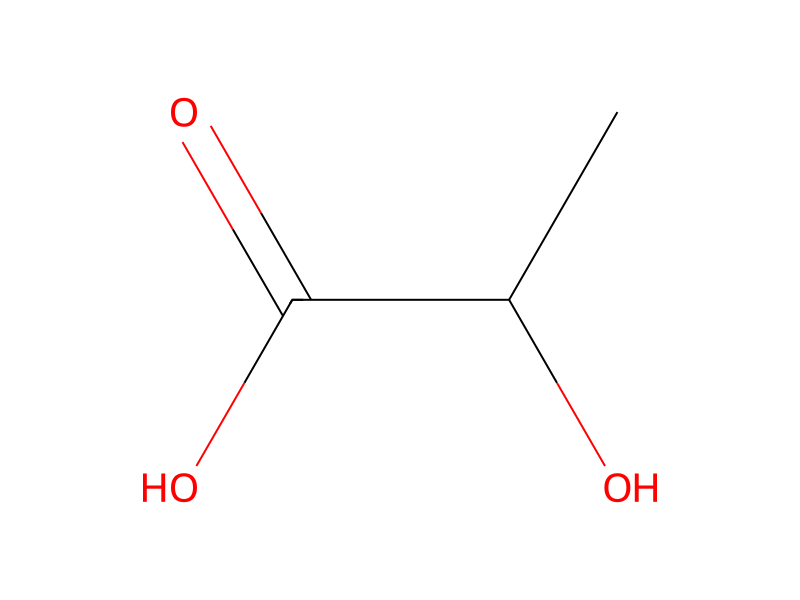


Product 1

Reagents, catalysts & solvents 1

Procedure
To the same glass reactor as that of Example 1, 13.3 g (0.1 mol) of L-aspartic acid made by Wako Pure Chemical Industries, Ltd., 50.1 g (0.5 mol) of 90% L-lactic acid made by Purac, and 18.5 mg (0.0016 mol) of titanium tetraisopropoxide made by Wako Pure Chemical Industries, Ltd. were supplied. In this case, the mol ratio of the aspartic acid supplied and the lactic acid supplied is 1:5. The reactor was immersed in an oil bath, and a stirring was carried out at 160° C. for 30 hours with flowing nitrogen. The powder was gradually disappeared in approximately 30 minutes to 1 hour, and the yellow coloration was observed in the reaction solution. The reactor was taken out from the oil bath, and the reaction solution was taken out on a stainless steel bat to be cooled and solidified. The light brownish yellow and transparent solid obtained was crushed to obtain 32 g of a powdery polymer. The Mw of the polymer was 6,200.
Workup
- customThe reactor was immersed in an oil bath
- waitThe powder was gradually disappeared in approximately 30 minutes to 1 hour
- temperatureto be cooled
- customThe light brownish yellow and transparent solid obtained
- customwas crushed
Sources & evidence
- ORD record
- ord-e387e2cd0e554170a0b945b30f9b813a
- Source dataset
- uspto-grants-2016_04
- Patent number
- US09309402B2
Reaction notes
Loading…