4-Hydroxybenzaldehyde → 4-(3,3,3-Trifluoropropoxy)benzaldehyde
Reaction equation

[OH:1][C:2]1[CH:9]=[CH:8][C:5]([CH:6]=[O:7])=[CH:4][CH:3]=1.[F:10][C:11]([F:16])([F:15])[CH2:12][CH2:13]I.C(=O)([O-])[O-].[Cs+].[Cs+].O>CN(C)C=O>[F:10][C:11]([F:16])([F:15])[CH2:12][CH2:13][O:1][C:2]1[CH:9]=[CH:8][C:5]([CH:6]=[O:7])=[CH:4][CH:3]=1Participants
6
Reactant 4



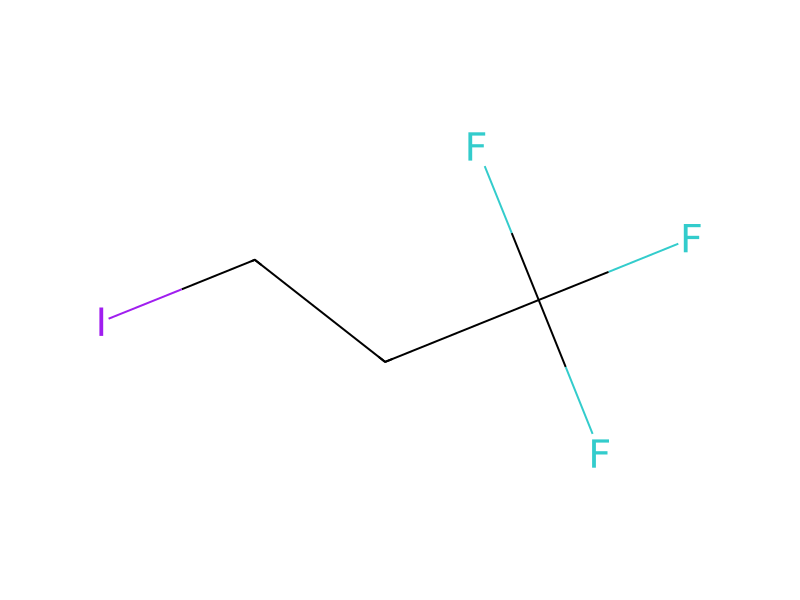
Product 1

Reagents, catalysts & solvents 1

Conditions
- Temperature
- 85 °C
Procedure
To a solution of 4-hydroxybenzaldehyde (740 mg, 6.0 mmol) and (3,3,3-trifluoro)-1-iodopropane (2.67 g, 12.0 mmol) in 10 mL dimethylformamide was added cesium carbonate (4.0 g, 12.3 mmol) and the resulting slurry stirred vigorously at 85° C. for 24 h. After cooling to room temperature the reaction mixture was poured into 100 mL water. Organics were extracted with ether (3×75 mL), dried over magnesium sulfate, filtered and concentrated. The residue was subjected to chromatography on silica gel (30% ethyl acetate in hexanes) to give 4-(3,3,3-trifluoropropoxyl)benzaldehyde (24 mg, 2%). Used without further characterization.
Workup
- temperatureAfter cooling to room temperature the reaction mixture
- extractionOrganics were extracted with ether (3×75 mL)
- dry with materialdried over magnesium sulfate
- filtrationfiltered
- concentrationconcentrated
Sources & evidence
- ORD record
- ord-19e517ecc7ff4ad6a304627158bbc676
- Source dataset
- uspto-grants-2016_04
- Patent number
- US09315495B2
Reaction notes
Loading…