Phenyl isocyanate → Phenylurea
Reaction equation

CO[C:3]1[CH:4]=[C:5]2[C:10](=[CH:11][C:12]=1OC)[N:9]=[CH:8][N:7]=C2OC1C=C(C=CC=1)N.C1(N=C=[O:31])C=CC=CC=1>C1COCC1>[C:10]1([NH:9][C:8](=[O:31])[NH2:7])[CH:5]=[CH:4][CH:3]=[CH:12][CH:11]=1Participants
4
Reactant 2


Product 1
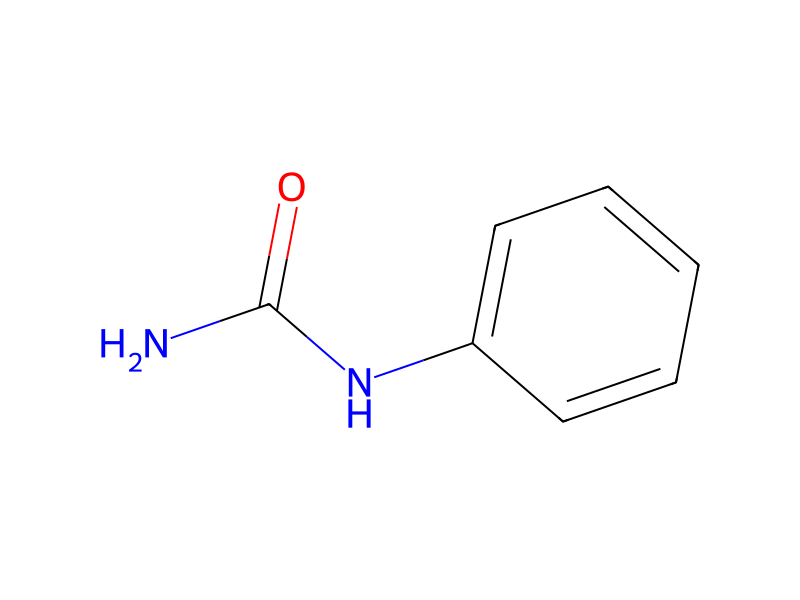
Reagents, catalysts & solvents 1

Procedure
To 3-(6,7-dimethoxyquinazolin-4-yloxy)aniline from Example 113A (89 mg, 0.3 mmol) in THF (3 mL) was added phenyl isocyanate (33 uL, 0.3 mmol) and the solution stirred at room temperature overnight. The reaction was concentrated in vacuo, diluted with EtOAc, and filtered to give 14346,7-dimethoxyquinazolin-4-yloxy)phenyl)-3-phenylurea (63 mg, 0.15 mmol, 50%). 1H NMR (300 MHz, DMSO-d6) δ 8.88 (s, 1H), 8.74 (s, 1H), 8.57 (s, 1H), 7.61-7.56 (m, 2H), 7.48-7.35 (m, 4H), 7.32-7.21 (m, 3H), 7.02-7.89 (m, 2H), 3.99 (s, 6H); LC-MS (ESI) m/z 417 (M+H)+.
Workup
- concentrationThe reaction was concentrated in vacuo
- additiondiluted with EtOAc
- filtrationfiltered
Sources & evidence
- ORD record
- ord-d8111ead98a34ab68e9e1f0e7921dd8b
- Source dataset
- uspto-grants-2016_04
- Patent number
- US09320739B2
Reaction notes
Loading…