Dimethylformamide dimethyl acetal → 1,2-Dihydro-6-(2-dimethylaminoethenyl)-2-oxo-5-(n-propanoyl)-3-pyridinecarbonitrile
Reaction equation

[CH3:1][C:2]1[NH:7][C:6](=[O:8])[C:5]([C:9]#[N:10])=[CH:4][C:3]=1[C:11](=[O:14])[CH2:12][CH3:13].CO[CH:17](OC)[N:18]([CH3:20])[CH3:19]>CN(C)C=O>[CH3:17][N:18]([CH3:20])[CH:19]=[CH:1][C:2]1[NH:7][C:6](=[O:8])[C:5]([C:9]#[N:10])=[CH:4][C:3]=1[C:11](=[O:14])[CH2:12][CH3:13]Participants
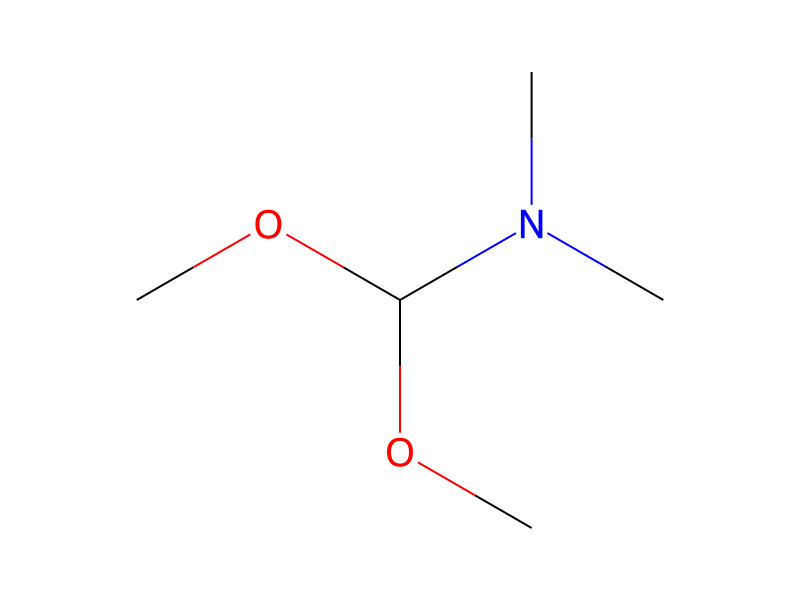



Procedure
A mixture containing 9.5 g of 1,2-dihydro-6-methyl-2-oxo-5-(n-propanoyl)-3-pyridinecarbonitrile, 50 ml of dimethylformamide and 8 ml of dimethylformamide dimethyl acetal was stirred at room temperature overnight and then concentrated to dryness on a rotary evaporator. The residue was refluxed with isopropyl alcohol; the insoluble yellow solid was collected, washed with isopropyl alcohol and dried at 90° C. to yield 2.8 g of 1,2-dihydro-6-(2-dimethylaminoethenyl)-2-oxo-5-(n-propanoyl)-3-pyridinecarbonitrile, m.p. 278°-280° C. with decomposition. The mother liquor was treated with decolorizing charcoal, filtered and concentrated to about 150 ml and allowed to stand at room temperature. The product that separated was collected, washed with isopropyl alcohol and dried to yield another 1.8 g of product, m.p. 270° C.
Workup
- concentrationconcentrated to dryness on a rotary evaporator
- temperatureThe residue was refluxed with isopropyl alcohol
- customthe insoluble yellow solid was collected
- washwashed with isopropyl alcohol
- customdried at 90° C.
Sources & evidence
- ORD record
- ord-d5dc6caf1c43490e8650e1e28a8bce9e
- Source dataset
- uspto-grants-1985_12
- Patent number
- US04559347
Reaction notes
Loading…