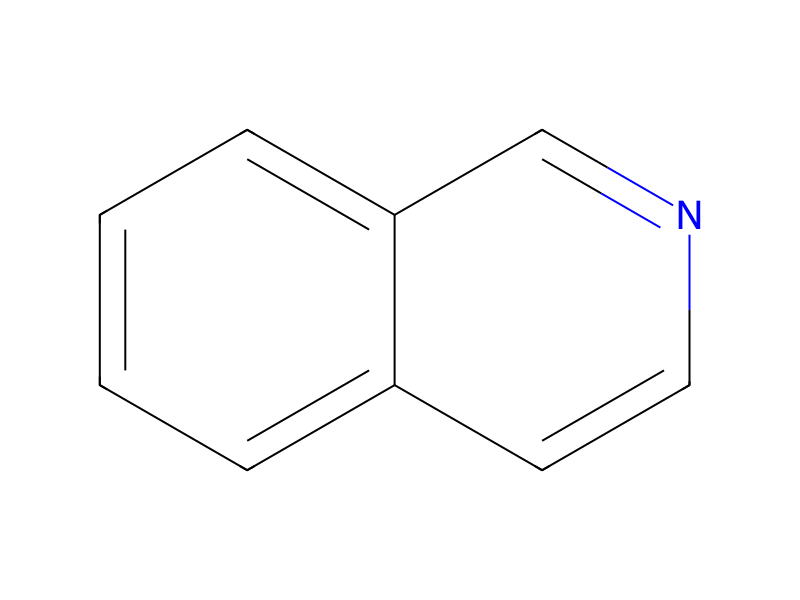
Triethylamine → Isoquinoline
Reaction equation

ClC[C:3]1[C:12]2[C:7](=[CH:8][C:9](OC)=[C:10](OC)[CH:11]=2)[C:6](CC2C=CC(OC)=C(OC)C=2)=[N:5][CH:4]=1.Cl.COC1C=CC(N2CCNCC2)=CC=1.C(N(CC)CC)C>CS(C)=O.O>[CH:6]1[C:7]2[C:12](=[CH:11][CH:10]=[CH:9][CH:8]=2)[CH:3]=[CH:4][N:5]=1Participants
6





Procedure
A mixture of 1.16 g of 4-chloromethyl-6,7-dimethoxy-1-[(3,4-dimethoxyphenyl)methyl]isoquinoline, 0.8 of 1-(para-methoxyphenyl)piperazine hydrochloride, and 1.3 ml of triethylamine in 10 ml dimethylsulfoxide was heated at 80° for one hour under argon. The cooled solution was then diluted with water and extracted with methylene chloride. The organic layer was washed with sodium bicarbonate solution, dried over sodium sulfate, charcoaled, and evaporated. The residue was crystallized from ethanol to give 1.3 g of 6,7-dimethoxy-1-{(3,4-dimethoxyphenyl)methyl}-4-[[4-methoxyphenyl)-1-piperazinyl]methyl]isoquinoline as a yellow solid, mp 176°-177°. Recrystallization from ethanol provided the analytical sample, mp 176-177°.
Workup
- temperaturewas heated at 80° for one hour under argon
- extractionextracted with methylene chloride
- washThe organic layer was washed with sodium bicarbonate solution
- dry with materialdried over sodium sulfate
- customevaporated
- customThe residue was crystallized from ethanol
Sources & evidence
- ORD record
- ord-5b36d0f3d1ae4de19583233bf81939ad
- Source dataset
- uspto-grants-1985_12
- Patent number
- US04559403
Reaction notes
Loading…