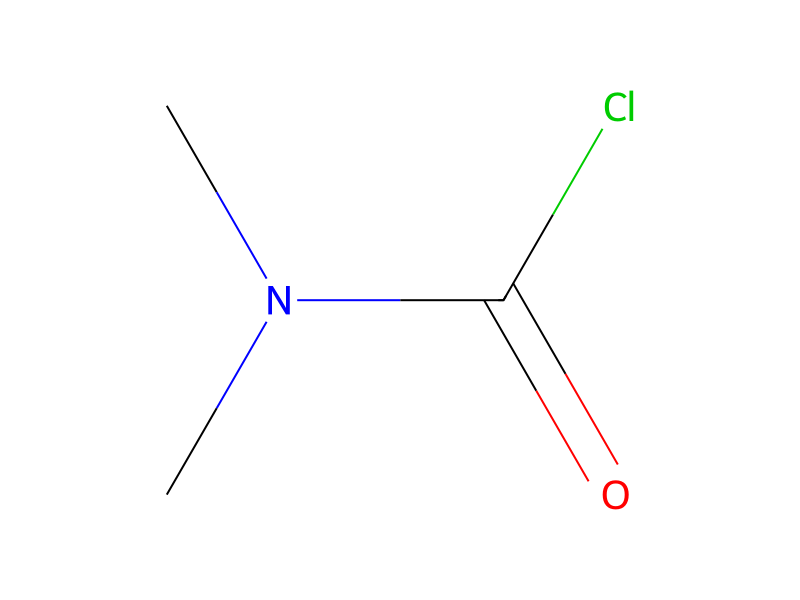
Dimethylcarbamoyl Chloride → HCID 54375653, compound
Reaction equation

[CH3:1][N:2]([CH3:6])[C:3](Cl)=[O:4].[Cl:7][C:8]([O:11][C:12]1[CH:17]=[CH:16][CH:15]=[CH:14][C:13]=1[S:18]([NH2:21])(=[O:20])=[O:19])=[CH:9][Cl:10].N12CCCN=C1CCCCC2>C(Cl)Cl>[Cl:7][C:8]([O:11][C:12]1[CH:17]=[CH:16][CH:15]=[CH:14][C:13]=1[S:18]([NH:21][C:3]([N:2]([CH3:6])[CH3:1])=[O:4])(=[O:19])=[O:20])=[CH:9][Cl:10]Participants
5




Procedure
A solution of 10.2 g of dimethylcarbamyl chloride in 10 ml of methylene chloride is added dropwise to a mixture of 10.7 g of 2-(1,2-dichlorovinyloxy)phenylsulfonamide, 12.2 g of 1,8-diazabicyclo[5.4.0]undec-7-ene in 100 ml of methylene chloride at 20° to 25° C. and the mixture is refluxed for 2 hours. The solvent is then evaporated off and the residue is dissolved in 5% sodium carbonate solution. The solution is filtered and acidified with 10% hydrochloric acid, whereupon the product precipitates as crystals. After filtration and drying, 12.1 g of N-[2-(1,2-dichlorovinyloxy)phenylsulfonyl]-N',N'-dimethylurea are obtained. Melting point: 218°-220° C.
Workup
- temperaturethe mixture is refluxed for 2 hours
- customThe solvent is then evaporated off
- dissolutionthe residue is dissolved in 5% sodium carbonate solution
- filtrationThe solution is filtered
- customprecipitates as crystals
- filtrationAfter filtration
- customdrying
Sources & evidence
- ORD record
- ord-d5e4e04caf7a45e2ad52b493bd4ba39a
- Source dataset
- uspto-grants-1985_12
- Patent number
- US04562210
Reaction notes
Loading…