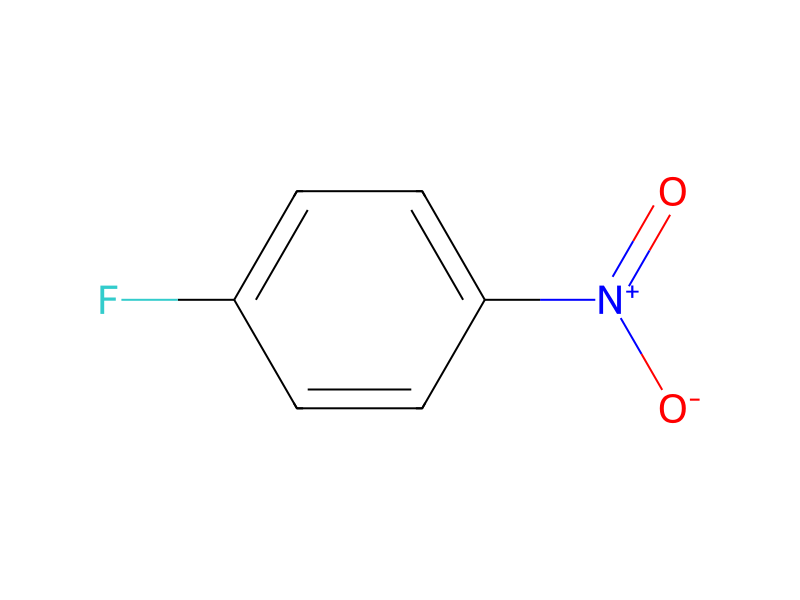
p-Fluoronitrobenzene → N1,N1-Dimethyl-N2-(4-nitro-phenyl)-propane-1,2-diamine
Reaction equation

[CH3:1][N:2]([CH3:7])[CH2:3][CH:4]([NH2:6])[CH3:5].C(=O)([O-])[O-].[K+].[K+].F[C:15]1[CH:20]=[CH:19][C:18]([N+:21]([O-:23])=[O:22])=[CH:17][CH:16]=1>CN(C=O)C>[CH3:1][N:2]([CH3:7])[CH2:3][CH:4]([NH:6][C:15]1[CH:20]=[CH:19][C:18]([N+:21]([O-:23])=[O:22])=[CH:17][CH:16]=1)[CH3:5]Participants




Conditions
- Temperature
- 110 °C
Procedure
A solution of N1,N1-Dimethyl-propane-1,2-diamine (10 mL, 77.4 mmol) in DMF (40 mL) at room temperature was treated with potassium carbonate (15.26 g, 1.5 equiv.) and 1-fluoro-4-nitrobenzene (8.21 mL, 1 equiv.). The reaction mixture was stirred at 110° C. overnight. The reaction mixture was cooled to room temperature, filtered to remove remaining solid potassium carbonate and diluted with CH2Cl2 (500 mL). The reaction mixture was extracted with H2O (3×500 mL) and dried over anhydrous MgSO4. Following filtration and concentration in vacuo the gelatinous red residue was purified by flash silica gel chromatography (CHCl3 to 1:4 MeOH:CHCl3 gradient eluant) to give N1,N1-Dimethyl-N2-(4-nitro-phenyl)-propane-1,2-diamine as a light brown oil (81.4%).
Workup
- temperatureThe reaction mixture was cooled to room temperature
- filtrationfiltered
- customto remove
- additiondiluted with CH2Cl2 (500 mL)
- extractionThe reaction mixture was extracted with H2O (3×500 mL)
- dry with materialdried over anhydrous MgSO4
- filtrationfiltration and concentration in vacuo the gelatinous red residue
- customwas purified by flash silica gel chromatography (CHCl3 to 1:4 MeOH:CHCl3 gradient eluant)
Sources & evidence
- ORD record
- ord-cc862463b20348fabd4764cfed16c037
- Source dataset
- uspto-grants-2010_04
- Patent number
- US07692005B2
Reaction notes
Loading…