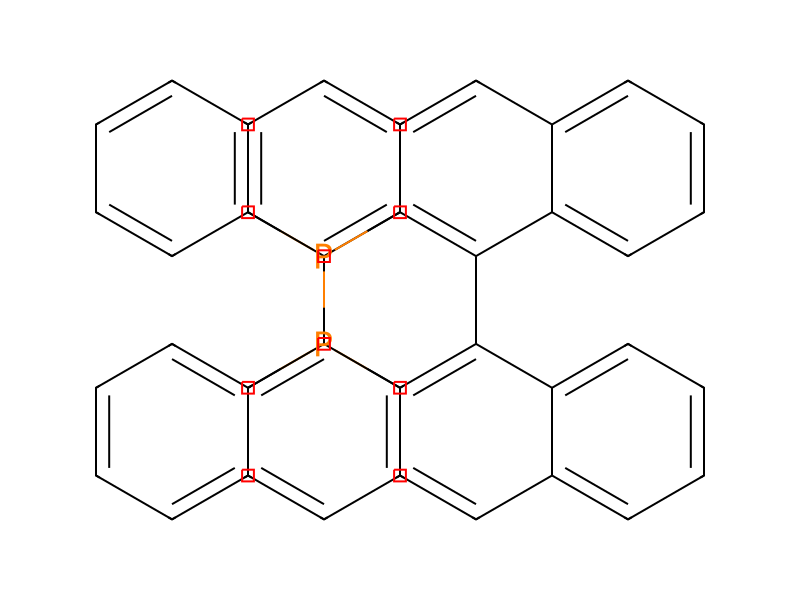
Binap, (A+-)- → Citronellol
Reaction equation

C1(P(C2C=CC=CC=2)C2C=CC3C(=CC=CC=3)C=2C2C3C(=CC=CC=3)C=CC=2P(C2C=CC=CC=2)C2C=CC=CC=2)C=CC=CC=1.[CH3:47][C:48](=[CH:50][CH2:51][CH2:52]/[C:53](=[CH:55]/[CH2:56][OH:57])/[CH3:54])[CH3:49].OC/C=C(/C)\CCC=C(C)C>P.[Rh].[Rh]>[CH3:47][C:48](=[CH:50][CH2:51][CH2:52][CH:53]([CH2:55][CH2:56][OH:57])[CH3:54])[CH3:49]Participants
Reactant 3


Product 1

Reagents, catalysts & solvents 2

Procedure
A number of organic synthetic reactions using metal complexes as a catalyst have been developed from old and utilized for many purposes. In particular, many reports have been made on asymmetric catalysts that are used in asymmetric syntheses typified by asymmetric isomerization and asymmetric hydrogenation. Among them, metal complexes composed of metallic rhodium and an optically active tertiary phosphine are well known as a catalyst for asymmetric hydrogenation, and a rhodium-phosphine complex using 2,2'-bis(diphenylphosphino)-1,1'-binaphthyl (hereinafter abbreviated as BINAP) as a ligand is reported in J. Am. Chem. Soc., 102, pp. 7932-7934 (1980). Further, it is reported in Inoue et al., Chemistry Letters, pp. 1007-1008 (1985) that asymmetric hydrogenation of geraniol or nerol was performed by using various rhodium-phosphine catalysts to obtain citronellol in an optical yield of 66% ee.
Sources & evidence
- ORD record
- ord-cc5e28b1ad884c01b6a278adecf1e1b9
- Source dataset
- uspto-grants-1988_04
- Patent number
- US04739085
Reaction notes
Loading…