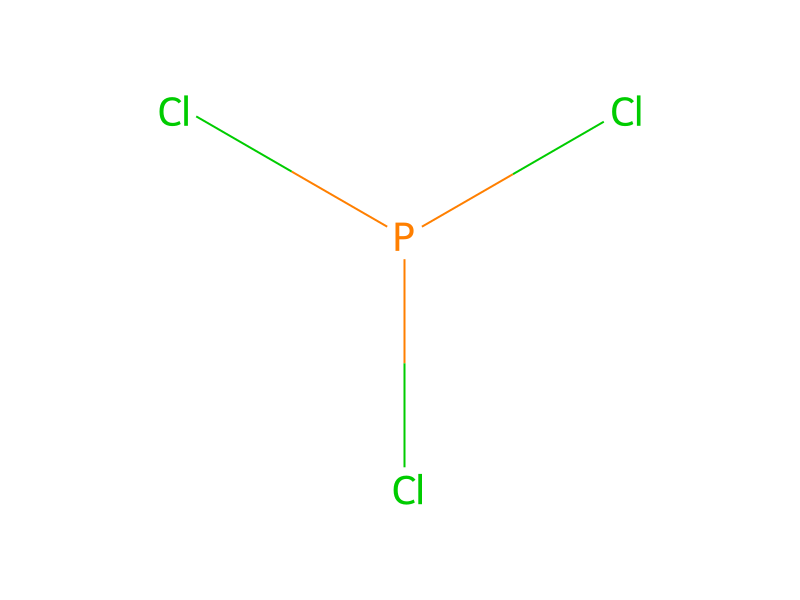
Phosphorus trichloride → 2,6-Dichlorobenzoxazole
Reaction equation

[Cl:1][C:2]1[CH:10]=[CH:9][C:5]2[N:6]=[CH:7][O:8][C:4]=2[CH:3]=1.P(Cl)(Cl)[Cl:12].[Cl-].[Cl-].[Cl-].[Al+3].ClCl>P(Cl)(Cl)(Cl)=O>[Cl:12][C:7]1[O:8][C:4]2[CH:3]=[C:2]([Cl:1])[CH:10]=[CH:9][C:5]=2[N:6]=1Participants
Reactant 4



Product 1

Reagents, catalysts & solvents 1

Conditions
- Temperature
- 100 °C
Procedure
10 g (0.065 mol) of 6-chlorobenzoxazole, 0.45 g of phosphorus trichloride and 0.09 g of anhydrous aluminum trichloride were initially charged in 30 ml of phosphorus oxychloride (POCl3). With heating and stirring, chlorine gas was introduced at a rate of 0.6 equivalent of chlorine per hour. After an internal temperature of 80° C. had been reached, the stream of chlorine gas was reduced to 0.6 equivalent of chlorine per 6 hours, and the temperature was increased to 100° C. The reaction was monitored by gas chromatography. After all of the starting material had been consumed, most of the POCl3 was distilled off and the residue was subjected to fractional distillation under reduced pressure. This gave a pure fraction of 11.9 g of the 2,6-dichlorobenzoxazole, which solidifies on cooling (GC>99% pure) (>97% of theory).
Workup
- temperatureWith heating
- customAfter an internal temperature of 80° C.
- customAfter all of the starting material had been consumed, most of the POCl3
- distillationwas distilled off
- distillationthe residue was subjected to fractional distillation under reduced pressure
Sources & evidence
- ORD record
- ord-d95e0b973a8842ecbf5ff31f0bd8edfb
- Source dataset
- uspto-grants-2001_08
- Patent number
- US06274739B1
Reaction notes
Loading…