Hydrochloric Acid → g-Phenylpropylphosphonate
Reaction equation

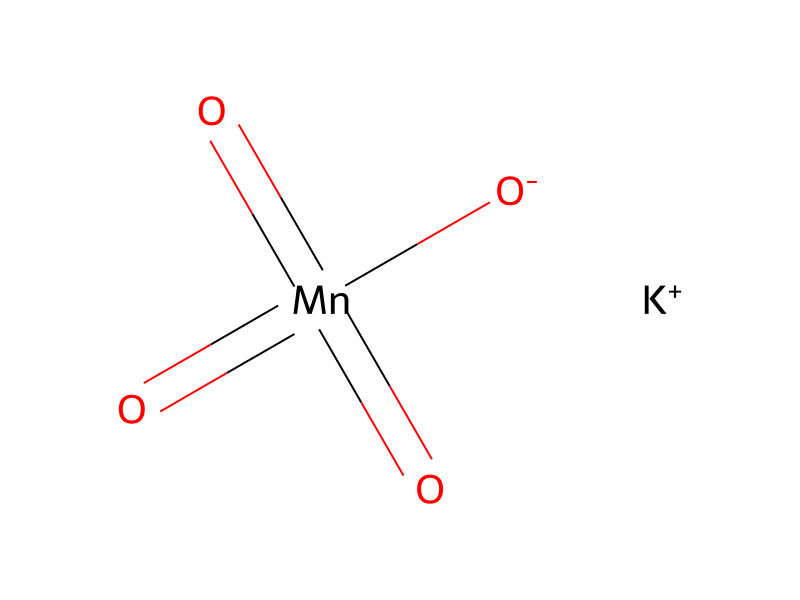
[C:1]1([CH2:7][CH2:8][CH2:9][P:10]([OH:12])[OH:11])[CH:6]=[CH:5][CH:4]=[CH:3][CH:2]=1.[OH-].[Na+].[O-:15][Mn](=O)(=O)=O.[K+].P(O)O.Cl.S(=O)(O)[O-].[Na+]>CC(C)=O.O>[C:1]1([CH2:7][CH2:8][CH2:9][P:10](=[O:15])([OH:12])[OH:11])[CH:6]=[CH:5][CH:4]=[CH:3][CH:2]=1Participants
9
Reactant 6





Product 1

Reagents, catalysts & solvents 2


Procedure
To a solution of 3-phenylpropyl phosphonous acid (0.92 g, 0.005 mole) in acetone (10 ml) and water (10 ml) was added a solution of sodium hydroxide (0.2 g, 0.005 mole) in water (10 ml) until a pH of about 7 was reached. A solution of KMnO4 (0.474 g, 0.003 mole) in water (10 ml) was added slowly to the vigorously stirred solution of phosphonous acid at 20°-25° C. After the addition (5 minutes), the reaction mixture was stirred for 5 minutes at ambient temperature and acidified with concentrated HCl acid until a pH of 1 was reached. Saturated sodium bisulfite solution was added to the reaction mixture thereby resulting in formation of a precipitate.
Workup
- additionAfter the addition (5 minutes)
- customthereby resulting in formation of a precipitate
Sources & evidence
- ORD record
- ord-4a0a1ce46ac040c3ab115b5c552108e5
- Source dataset
- uspto-grants-1987_06
- Patent number
- US04670193
Reaction notes
Loading…