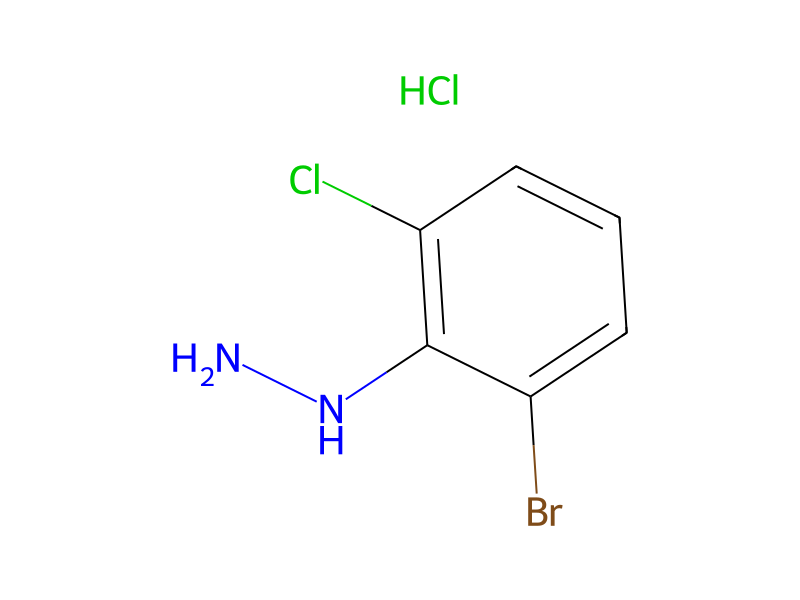
Hydrochloric Acid → (2-Bromo-6-chlorophenyl)hydrazine hydrochloride
Reaction equation

Cl.O1CCOCC1.[Br:8][C:9]1[CH:14]=[CH:13][CH:12]=[C:11]([Cl:15])[C:10]=1[N:16](C(OC(C)(C)C)=O)[NH:17]C(OC(C)(C)C)=O>CC(O)C>[ClH:15].[Br:8][C:9]1[CH:14]=[CH:13][CH:12]=[C:11]([Cl:15])[C:10]=1[NH:16][NH2:17]Participants
5




Conditions
- Temperature
- 60 °C
Procedure
4M Hydrogen chloride in dioxane (28.2 mL, 112.64 mmol) was added to di-tert-butyl 1-(2-bromo-6-chlorophenyl)hydrazine-1,2-dicarboxylate (Intermediate AH1) (9.5 g, 22.53 mmol) in iPrOH (30 mL) at ambient temperature. The resulting solution was heated to 60° C. and stirred for 20 minutes. The reaction mixture was allowed to cool to ambient temperature. A solid was filtered off, and dried under vacuum to afford the product (4.71 g). 1H NMR (400 MHz, DMSO) d 6.97 (1H, s), 7.06 (1H, t), 7.41 (1H, dd), 7.52 (1H, dd), 9.83 (3H, s). m/z M+=220; GC-MS tR=10.419 min.
Workup
- temperatureto cool to ambient temperature
- filtrationA solid was filtered off
- customdried under vacuum
Sources & evidence
- ORD record
- ord-7991c797bc964019a92f73a91392b2d8
- Source dataset
- uspto-grants-2011_12
- Patent number
- US08071608B2
Reaction notes
Loading…