Triethylamine → HCID 59799766, compound
Reaction equation

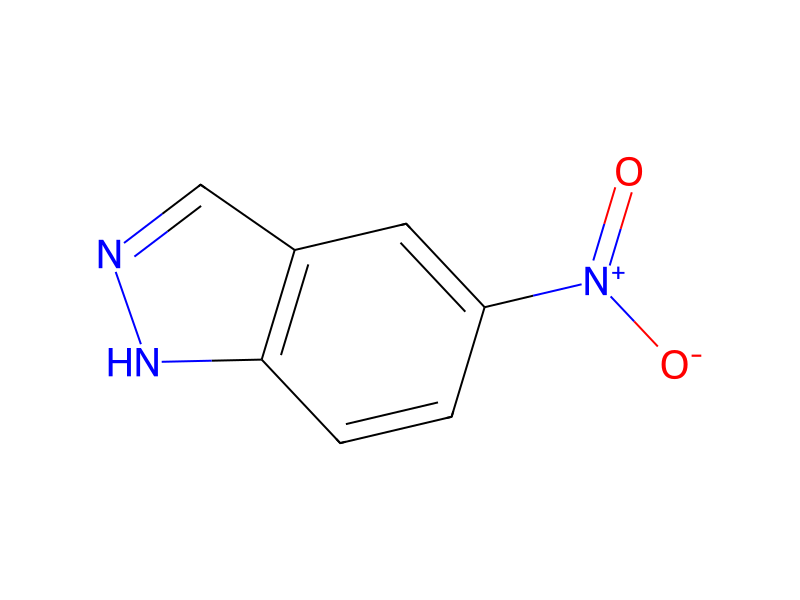
[N+:1]([C:4]1[CH:5]=[C:6]2[C:10](=[CH:11][CH:12]=1)[NH:9][N:8]=[CH:7]2)([O-:3])=[O:2].C(N(CC)CC)C.[C:20](Cl)(=[O:25])[C:21]([CH3:24])([CH3:23])[CH3:22]>O1CCCC1>[CH3:22][C:21]([CH3:24])([CH3:23])[C:20]([N:9]1[C:10]2[C:6](=[CH:5][C:4]([N+:1]([O-:3])=[O:2])=[CH:12][CH:11]=2)[CH:7]=[N:8]1)=[O:25]Participants
5
Reactant 3


Product 1

Reagents, catalysts & solvents 1

Conditions
- Temperature
- 0 °C
Procedure
A 4 L 3-neck round bottom flask fitted with a nitrogen inlet and mechanical stirrer was charged with a solution of 5-nitroindazole (80.0 g, 0.49 mol) in tetrahydrofuran (1 L). The mixture was cooled to 0° C. and triethylamine (85.4 mL, 0.61 mol) was added. To the mixture was added pivaloyl chloride (63.4 mL, 0.52 mol) dropwise over a period of 15 minutes. The reaction was allowed to warm to 20° C. over a period of 2 hours. The reaction was filtered and concentrated to a dark red oil. To the oil was added methylene chloride (60 mL). The resulting slurry was stirred vigorously, giving a white precipitate that was isolated by filtration. The solid was dried in a vacuum oven at 40° C. overnight to afford the title compound (95 g, 79%).
Workup
- customA 4 L 3-neck round bottom flask fitted with a nitrogen inlet and mechanical stirrer
- temperatureto warm to 20° C. over a period of 2 hours
- filtrationThe reaction was filtered
- concentrationconcentrated to a dark red oil
- additionTo the oil was added methylene chloride (60 mL)
- customgiving a white precipitate that
- customwas isolated by filtration
- customThe solid was dried in a vacuum oven at 40° C. overnight
Sources & evidence
- ORD record
- ord-600e16c6c8f24095bc7b06aee0e4e64e
- Source dataset
- uspto-grants-2011_12
- Patent number
- US08071779B2
Reaction notes
Loading…