Benzyl Alcohol → BOC-L-Alanine benzyl ester
Reaction equation

[C:1]([O:5][C:6]([NH:8][C@H:9]([C:11]([OH:13])=[O:12])[CH3:10])=[O:7])([CH3:4])([CH3:3])[CH3:2].[CH2:14](O)[C:15]1[CH:20]=[CH:19][CH:18]=[CH:17][CH:16]=1.CCN=C=NCCCN(C)C>C(Cl)Cl.CN(C1C=CN=CC=1)C>[C:1]([O:5][C:6]([NH:8][C@H:9]([C:11]([O:13][CH2:14][C:15]1[CH:20]=[CH:19][CH:18]=[CH:17][CH:16]=1)=[O:12])[CH3:10])=[O:7])([CH3:2])([CH3:3])[CH3:4]Participants
6

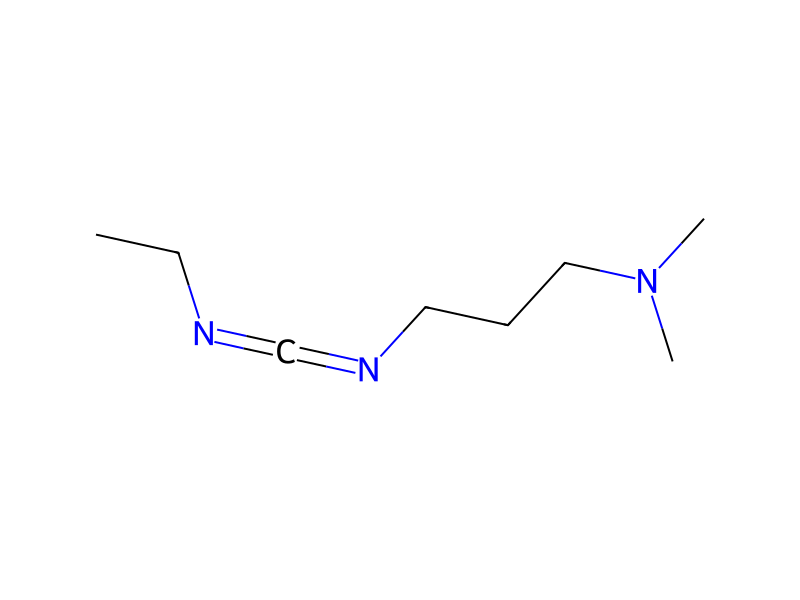




Conditions
- Temperature
- 0 °C
Procedure
N2-(tert-Butoxycarbonyl)-L-alanine (1.13 g, 5.83 mmol) is dissolved in dry DCM (6 ml), some 3 Å molecular sieves are added, and the mixture is then cooled to 0° C. Benzyl alcohol (1.81 ml, 17.48 mmol, 3 equivalents), EDCI (2.23 g, 11.65 mmol, 2 equivalents), and DMAP (71 mg, 0.58 mmol, 0.1 equivalent) are added. The mixture is stirred for 150 min, during which it is allowed to slowly warm to RT. The mixture is then concentrated to dryness and the residue is worked up by chromatography (Biotage, cyclohexane-ethyl acetate 9:1). Product-containing fractions are combined and concentrated. The title compound is obtained in a yield of 1.03 g (63% of theory).
Workup
- additionsome 3 Å molecular sieves are added
- temperatureto slowly warm to RT
- concentrationThe mixture is then concentrated to dryness
- concentrationconcentrated
Sources & evidence
- ORD record
- ord-4bb3046da8214611b31a702bd301d7c5
- Source dataset
- uspto-grants-2011_12
- Patent number
- US08076285B2
Reaction notes
Loading…