4-Hydroxybenzaldehyde → N,N'-Bis-(4-hydroxybenzyl)-1,2-diaminoethane
Reaction equation

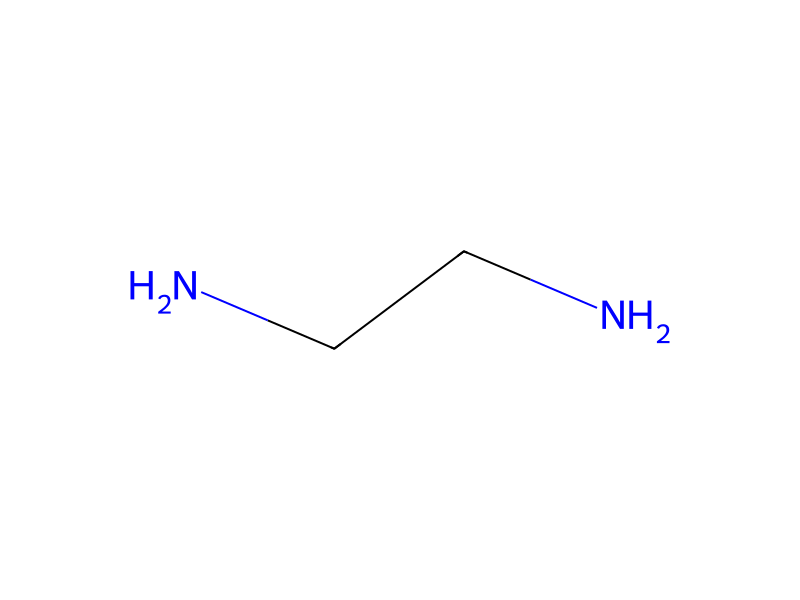
[OH:1][C:2]1[CH:9]=[CH:8][C:5]([CH:6]=O)=[CH:4][CH:3]=1.[CH2:10]([NH2:13])[CH2:11][NH2:12]>C(O)(=O)C.[Pt]>[OH:1][C:2]1[CH:9]=[CH:8][C:5]([CH2:6][NH:12][CH2:11][CH2:10][NH:13][CH2:6][C:5]2[CH:8]=[CH:9][C:2]([OH:1])=[CH:3][CH:4]=2)=[CH:4][CH:3]=1Participants
Reactant 2

Product 1

Reagents, catalysts & solvents 2


Conditions
- Temperature
- 60 °C
Procedure
24.16 g of a bisazomethine prepared from 2 mols of p-hydroxybenzaldehyde and 1 mol of ethylenediamine and with a melting point of 215°-216° C. (decomposition) are hydrogenated in 150 ml of glacial acetic acid with 0.5 g of 10% platinum/charcoal at 25° C. in a hydrogenation flask. After 24 hours no further H2 is taken up. The catalyst is filtered off and the filtrate is concentrated in a rotary evaporator. The residue is crystalline and is stirred with 90 ml of isopropanol at 60° C.; the crystals do not dissolve. They are filtered off at room temperature, washed with isopropanol, and dried at 80° C. in vacuo. Yield 30.65 g (86.8% of theory) of the diacetate of N,N'-bis-(4-hydroxybenzyl)-1,2-diaminoethan with a melting point of 152°-155° C. The NMR spectrum confirms the structure of the diacetate.
Workup
- filtrationThe catalyst is filtered off
- concentrationthe filtrate is concentrated in a rotary evaporator
- dissolutionthe crystals do not dissolve
- filtrationThey are filtered off at room temperature
- washwashed with isopropanol
- customdried at 80° C. in vacuo
Sources & evidence
- ORD record
- ord-ba6e01af16ab4eb9b7bf21c9563fc311
- Source dataset
- uspto-grants-1978_12
- Patent number
- US04129556
Reaction notes
Loading…