Diisopropyl Ether → HCID 20527426, compound
Reaction equation
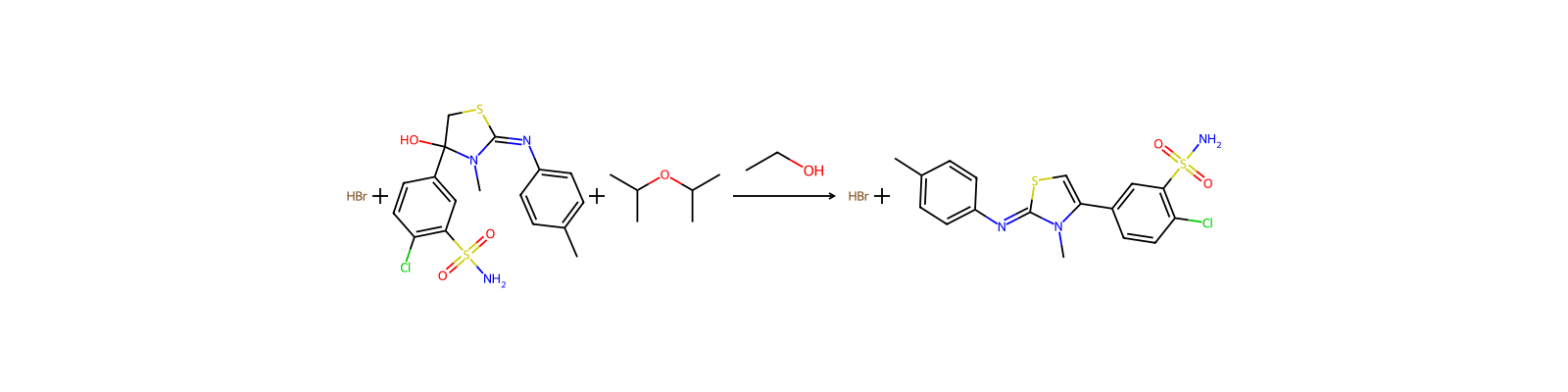
[BrH:1].[Cl:2][C:3]1[CH:8]=[CH:7][C:6]([C:9]2(O)[CH2:13][S:12][C:11](=[N:14][C:15]3[CH:20]=[CH:19][C:18]([CH3:21])=[CH:17][CH:16]=3)[N:10]2[CH3:22])=[CH:5][C:4]=1[S:24](=[O:27])(=[O:26])[NH2:25].C(OC(C)C)(C)C>C(O)C>[BrH:1].[Cl:2][C:3]1[CH:8]=[CH:7][C:6]([C:9]2[N:10]([CH3:22])[C:11](=[N:14][C:15]3[CH:16]=[CH:17][C:18]([CH3:21])=[CH:19][CH:20]=3)[S:12][CH:13]=2)=[CH:5][C:4]=1[S:24](=[O:26])(=[O:27])[NH2:25]Participants
4
Reactant 2


Product 1

Reagents, catalysts & solvents 1

Procedure
0.02 mole (9.8 g) of 4-(4-chloro-3-sulfamoylphenyl)-3-methyl-2-(4-methylphenyl-imino)-thiazolidin-4-ol hydrobromide are boiled in 120 ml of ethanol for 2 hours under reflux. After cooling to room temperature, 200 ml of diisopropyl ether are added and the crystals are filtered off. Melting point 265° C. (with decomposition).
Workup
- temperatureunder reflux
- filtrationthe crystals are filtered off
Sources & evidence
- ORD record
- ord-3e3fc435b5a748fdb25a38e297db18be
- Source dataset
- uspto-grants-1982_08
- Patent number
- US04346088
Reaction notes
Loading…