Sodium hydride → 4-Chloro-1-[[2-(trimethylsilyl)ethoxy]methyl]-1H-pyrrolo[3,2-c]pyridine
Reaction equation

[Cl:1][C:2]1[C:7]2[CH:8]=[CH:9][NH:10][C:6]=2[CH:5]=[CH:4][N:3]=1.[H-].[Na+].[CH3:13][Si:14]([CH3:21])([CH3:20])[CH2:15][CH2:16][O:17][CH2:18]Cl>O1CCCC1>[Cl:1][C:2]1[C:7]2[CH:8]=[CH:9][N:10]([CH2:18][O:17][CH2:16][CH2:15][Si:14]([CH3:21])([CH3:20])[CH3:13])[C:6]=2[CH:5]=[CH:4][N:3]=1Participants

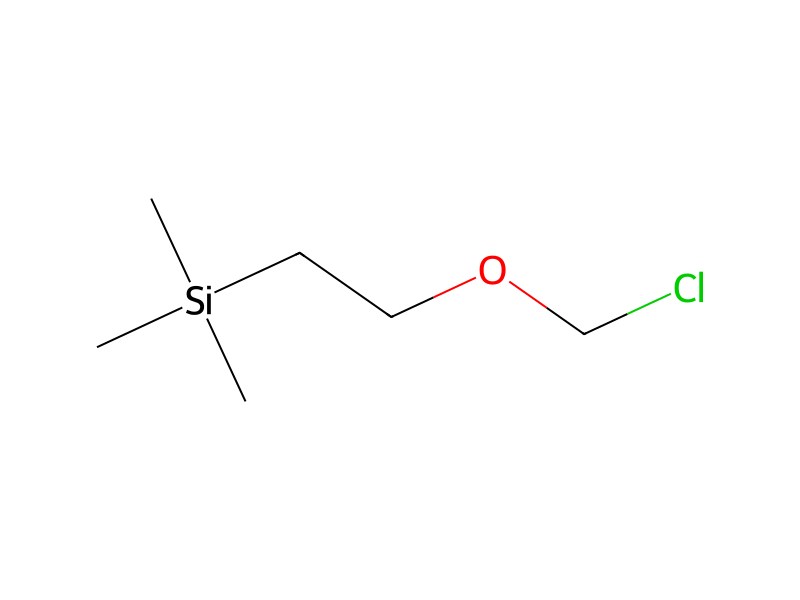



Conditions
- Temperature
- 0 °C
Procedure
A mixture of 4-chloro-1H-pyrrolo[3,2-c]pyridine (98%, 2.0 g, 13 mmol) and tetrahydrofuran (20 mL) was cooled to 0° C. Sodium hydride (60% in oil, 1.03 g, 25.8 mmol) was added portion-wise over 5 minutes, and the reaction mixture was allowed to stir at 0° C. for 10 minutes. 2-(Trimethylsilyl)ethoxymethyl chloride (3.40 mL, 19.3 mmol) was then added drop-wise over 5 minutes, and stirring was continued at 0° C. for 15 minutes. The reaction mixture was quenched with saturated aqueous ammonium chloride solution; the aqueous layer was extracted twice with ethyl acetate, and the combined organic layers were dried over sodium sulfate, filtered, and concentrated in vacuo. Silica gel chromatography (Gradient: 10% to 20% ethyl acetate in heptane) afforded the product as a colorless oil. Yield: 2.64 g, 9.33 mmol, 72%. LCMS m/z 283.0 [M+H+]. 1H NMR (400 MHz, CDCl3) δ 8.13 (d, J=5.8 Hz, 1H), 7.34 (dd, J=5.8, 0.7 Hz, 1H), 7.25 (d, J=3.3 Hz, 1H), 6.69 (dd, J=3.3, 0.7 Hz, 1H), 5.48 (s, 2H), 3.46 (dd, J=8.2, 8.1 Hz, 2H), 0.89 (dd, J=8.2, 8.1 Hz, 2H), −0.05 (s, 9H).
Workup
- stirringstirring
- waitwas continued at 0° C. for 15 minutes
- customThe reaction mixture was quenched with saturated aqueous ammonium chloride solution
- extractionthe aqueous layer was extracted twice with ethyl acetate
- dry with materialthe combined organic layers were dried over sodium sulfate
- filtrationfiltered
- concentrationconcentrated in vacuo
Sources & evidence
- ORD record
- ord-53788ef2e0e34a239bd3eebf309d2748
- Source dataset
- uspto-grants-2014_09
- Patent number
- US08822494B2
Reaction notes
Loading…