Water → HCID 15053101, compound
Reaction equation

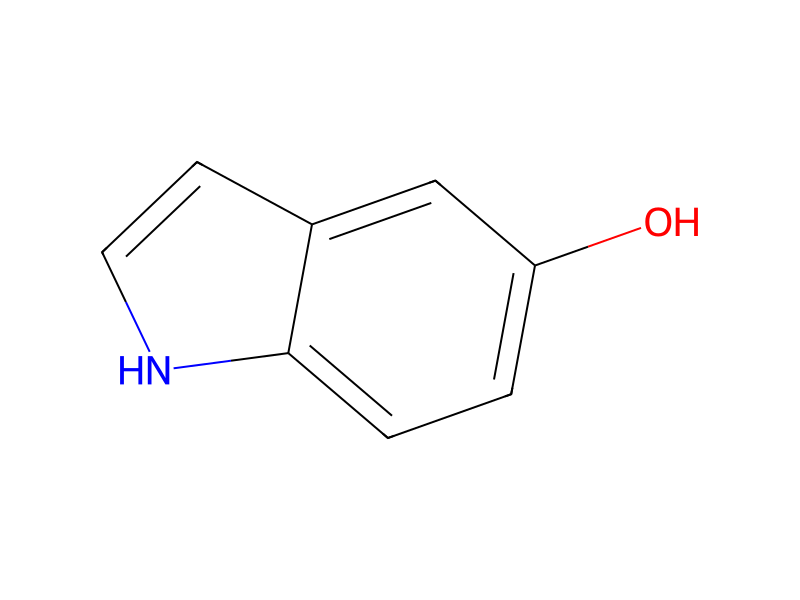
[OH:1][C:2]1[CH:3]=[C:4]2[C:8](=[CH:9][CH:10]=1)[NH:7][CH:6]=[CH:5]2.C([O-])([O-])=O.[K+].[K+].Cl[C:18]1[CH:23]=[CH:22][N:21]=[CH:20][C:19]=1[N+:24]([O-:26])=[O:25].O>CN(C=O)C>[N+:24]([C:19]1[CH:20]=[N:21][CH:22]=[CH:23][C:18]=1[O:1][C:2]1[CH:3]=[C:4]2[C:8](=[CH:9][CH:10]=1)[NH:7][CH:6]=[CH:5]2)([O-:26])=[O:25]Participants
6
Reactant 4



Product 1

Reagents, catalysts & solvents 1

Procedure
To a solution of 5-hydroxyindole (7.45 g) in 100 ml of DMF was added K2CO3 (10.4 g). This mixture was stirred for 10 minutes at room temperature and then a solution of 4-chloro-3-nitropyridine (11.89 g) in 50 ml DMF was added dropwise. The reaction was allowed to proceed for 24 hours at room temperature. The mixture was poured into water and extracted with ethyl acetate. The organic layer was washed with water and saturated NaCl solution and dried over MgSO4. After filtration, the solvent was evaporated to yield an oil (15.4 g). This material was eluted with 5% ethyl acetate/DCM on a silica gel column via HPLC. The desired fractions were concentrated to yield a solid, 1.35 g, m.p. 182°-184° C.
Workup
- waitto proceed for 24 hours at room temperature
- extractionextracted with ethyl acetate
- washThe organic layer was washed with water and saturated NaCl solution
- dry with materialdried over MgSO4
- filtrationAfter filtration
- customthe solvent was evaporated
Sources & evidence
- ORD record
- ord-2e52797c9c28408999c3f29118704854
- Source dataset
- uspto-grants-1991_01
- Patent number
- US04983615
Reaction notes
Loading…