Benzoic Acid → Benzoic Acid
Reaction equation
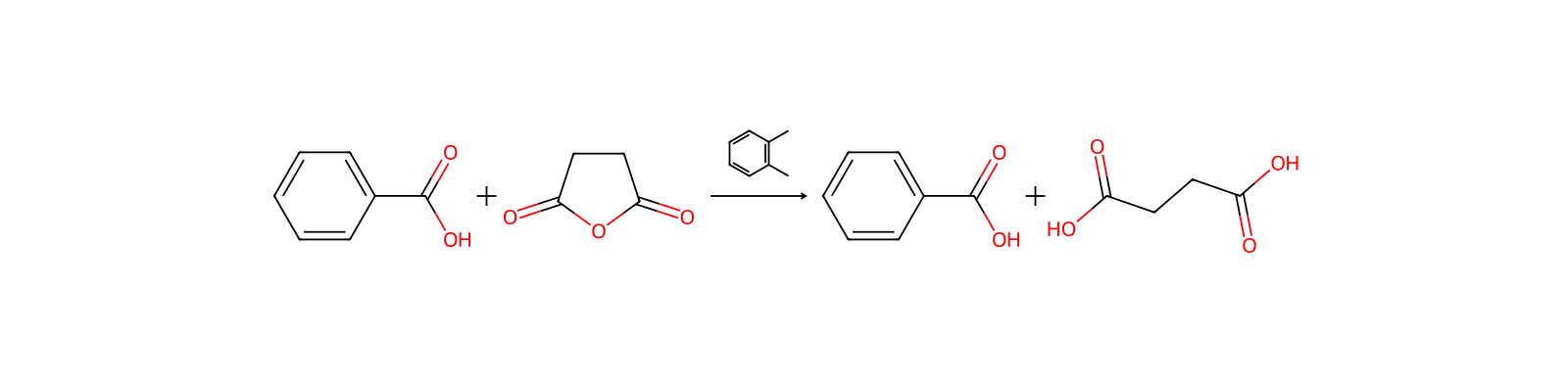
[C:1]([OH:9])(=[O:8])[C:2]1[CH:7]=[CH:6][CH:5]=[CH:4][CH:3]=1.[C:10]1(=[O:16])[O:15][C:13](=[O:14])[CH2:12][CH2:11]1>CC1C=CC=CC=1C>[C:1]([OH:9])(=[O:8])[C:2]1[CH:7]=[CH:6][CH:5]=[CH:4][CH:3]=1.[C:10]([OH:15])(=[O:16])[CH2:11][CH2:12][C:13]([OH:8])=[O:14]Participants
Reactant 2
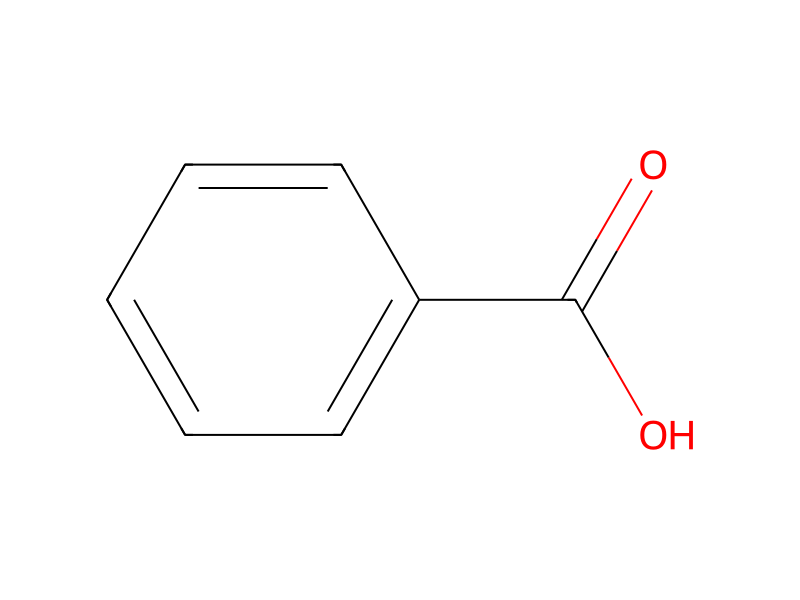

Product 2

Reagents, catalysts & solvents 1
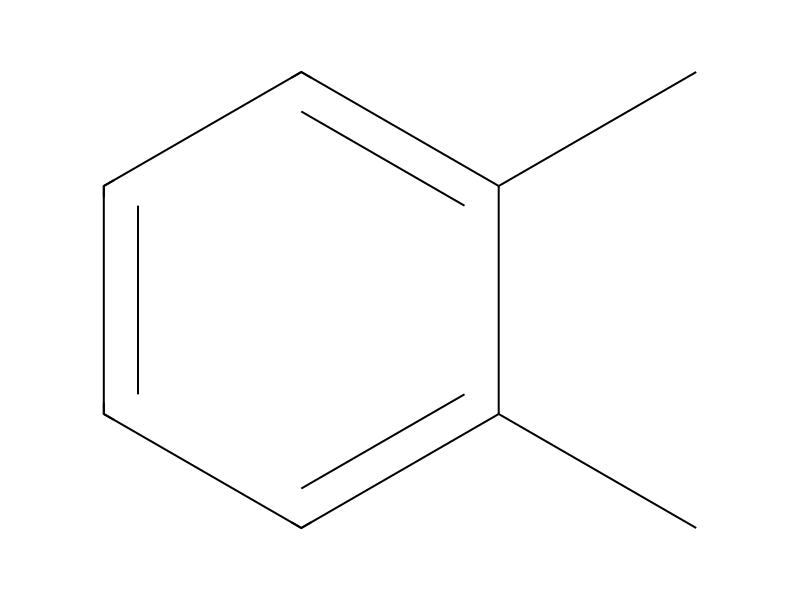
Conditions
- Temperature
- 165 °C
Procedure
This Example describes a process used for making reaction product 6 as indicated in Table 2, namely a reaction product of di-isopropanolamine, benzoic acid and succinic acid anhydride. A 1 liter reaction flask was provided with a mechanical agitator, a thermometer and a DeanStark arrangement. 261.06 g (1.960 mol) of di-isopropanolamine (type S, BASF) 540.88 g (4.429 mol) benzoic acid (Aldrich) and 69.69 g (0.696 mol) of succinic acid anhydride (Aldrich) were placed in the flask. A small quantity of o-xylene, about 60 ml, was added as entraining agent to remove the liberated water. The reaction mixture was kept under a nitrogen atmosphere and heated for 1 hour at 165° C., whereafter the reaction temperature was raised to 180° C. After 6 hours the temperature was reduced to 160° C. and the flask was evacuated to remove the o-xylene. It was possible to draw off the reaction mixture after about 1 hour. Analysis showed that the number-averaged molecular weight (Mn) was 583 and the weight-averaged molecular weight (Mw) was 733. The ratio between Mw and Mn (1.26) showed that there was a mixture of compounds formed. The diagram below (formula 1) indicates what compounds may form during the reaction between di-isopropanolamine, benzoic acid and succinic acid (it should be noted that formula 1 is the most probable structure of the resulting compounds). The reaction shows the formation of a mono-disperse compound. The ratio in respect of reactants as indicated in the formula belongs to a chosen value for n. This ratio need not necessarily be identical to the ratio for the overall reaction, where in fact a mixture of compounds with different values for n is formed. In the reaction according to this example, a ratio has been chosen which is equal to 2.82:6.36:1 (di-isopropanolamine:benzoic acid:succinic acid anhydride). This means that there are 3×2.82=8.46 mol equivalents of reactive NH/OH groups in the amine, as against 6.36+2×1.00=8.36 mol equivalents of acid groups in the benzoic acid and anhydride. There is therefore only a very small excess (about 1%) of di-isopropanolamine.
Workup
- customA 1 liter reaction flask
- customwas provided with a mechanical agitator
- customto remove the liberated water
- temperaturewas raised to 180° C
- customthe flask was evacuated
- customto remove the o-xylene
- customafter about 1 hour
- additiona mixture of compounds
- customformed
Sources & evidence
- ORD record
- ord-31e32b715b4240b3acd76a37764f4545
- Source dataset
- uspto-grants-2006_08
- Patent number
- US07084190B2
Reaction notes
Loading…