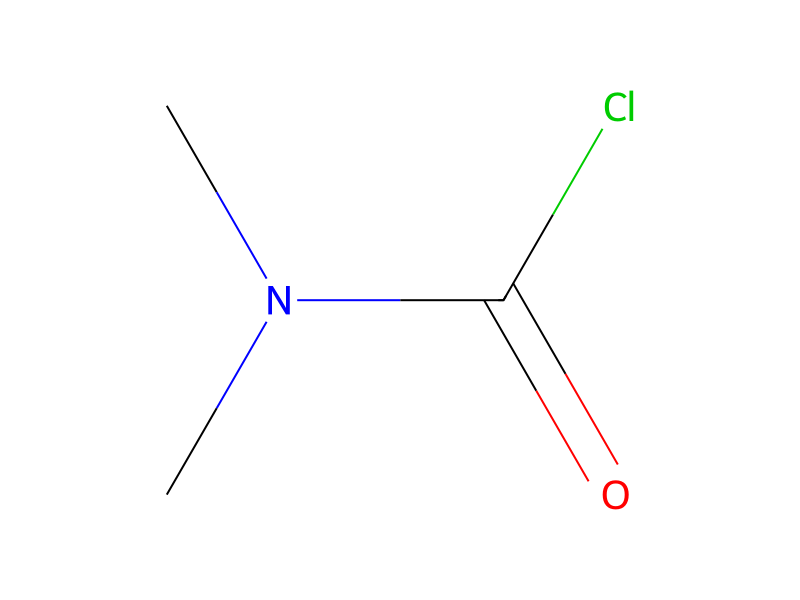
Dimethylcarbamoyl Chloride → 4,5-Dimethylpyridine-2-carbonitrile
Reaction equation

[CH3:1][C:2]1[CH:3]=[N+:4]([O-])[CH:5]=[CH:6][C:7]=1[CH3:8].[CH3:10][N:11](C)C(Cl)=O.C[Si](C#N)(C)C>C(Cl)Cl>[C:10]([C:5]1[N:4]=[CH:3][C:2]([CH3:1])=[C:7]([CH3:8])[CH:6]=1)#[N:11]Participants
5
Reactant 3


Product 1

Reagents, catalysts & solvents 1

Procedure
17.8 g of the obtained 3,4-dimethylpyridine-N-oxide (144.5 mmol) was dissolved under an argon gas atmosphere in 250 mL of methylene dichloride, added thereto 13.2 mL of dimethyl carbamoyl chloride (144 mmol), then 19.0 mL of trimethylsilyl cyanide (152 mmol), and stirred overnight at room temperature. The reaction solution was quenched with 10%-K2CO3 aqueous solution, the methylene dichloride layer was separated, dried on salt cake and concentrated to give 3.40 g of 6-cyano-3,4-dimethylpyridine (18% yield).
Workup
- additionadded
- customThe reaction solution was quenched with 10%-K2CO3 aqueous solution
- customthe methylene dichloride layer was separated
- customdried on salt cake
- concentrationconcentrated
Sources & evidence
- ORD record
- ord-c7130fc8c111404c873fc7fd6081327f
- Source dataset
- uspto-grants-2015_11
- Patent number
- US09174906B2
Reaction notes
Loading…