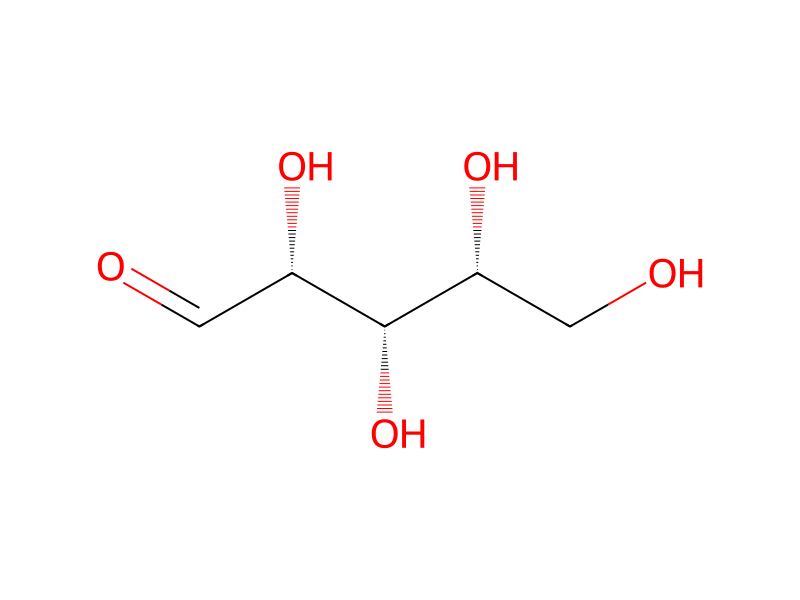
DL-Arabinose → Furfural
Reaction equation

[CH:1](=[O:7])[C:2]1[O:6][CH:5]=[CH:4][CH:3]=1.[CH2:8]([OH:17])[CH:9]([OH:16])[CH:10]([OH:15])[CH:11]([OH:14])[CH:12]=[O:13]>>[CH:1](=[O:7])[C:2]1[O:6][CH:5]=[CH:4][CH:3]=1.[O:13]=[CH:12][C@@H:11]([C@H:10]([C@@H:9]([CH2:8][OH:17])[OH:16])[OH:15])[OH:14]Participants


Procedure
In a process disclosed by David J. Medeiros et al. in U.S. Pat. No. 4,533,743, aqueous pentose solution was reacted at high temperature and pressure in the presence of a mineral acid catalyst to maximize furfural yield and selectivity. The process utilized a plug flow reactor and a combination of four conditions: The concentration of pentose in the pentose-aqueous feed solution before entry into the reactor was between 1 and 10 percent by weight of the aqueous solution before the addition of acid; the concentration of the mineral acid in the reactor was between 0.05 and 0.2 normality before entry into the reactor; the reactor was operated at a temperature between 220° C. and 300° C.; and the residence time of the pentose in the reactor was between 0.5 and 100 seconds. The reactor pressure was high enough to prevent vaporization of the aqueous solutions at the high temperatures used, between about 1000 and 2000 psi (6.895 and 13.79 MPa). In one configuration of the process, furfural produced from a xylose stream was separated with a water immiscible extraction solvent. The yield of furfural was 66% after one pass. Because incomplete conversion of the xylose took place, the aqueous solution could be recycled for additional yield. The selectivity of the xylose converted was 73%. Faster flow rates increased selectivity at the expense of lowered conversion, suggesting that maximum yields using multiple cycles would reach 80-85%. In a second configuration, the aqueous xylose solution was mixed with an immiscible solvent, toluene, before reaction. The conversion was 98% and the yield was 71%.
Workup
- customyield
- additionbefore the addition of acid
- customwas operated at a temperature between 220° C. and 300° C.
Sources & evidence
- ORD record
- ord-c1038da63bfc4d859f20fdd5df19fa1d
- Source dataset
- uspto-grants-2015_11
- Patent number
- US09181209B2
Reaction notes
Loading…