Cyclohexylamine → HCID 86717445, compound
Reaction equation
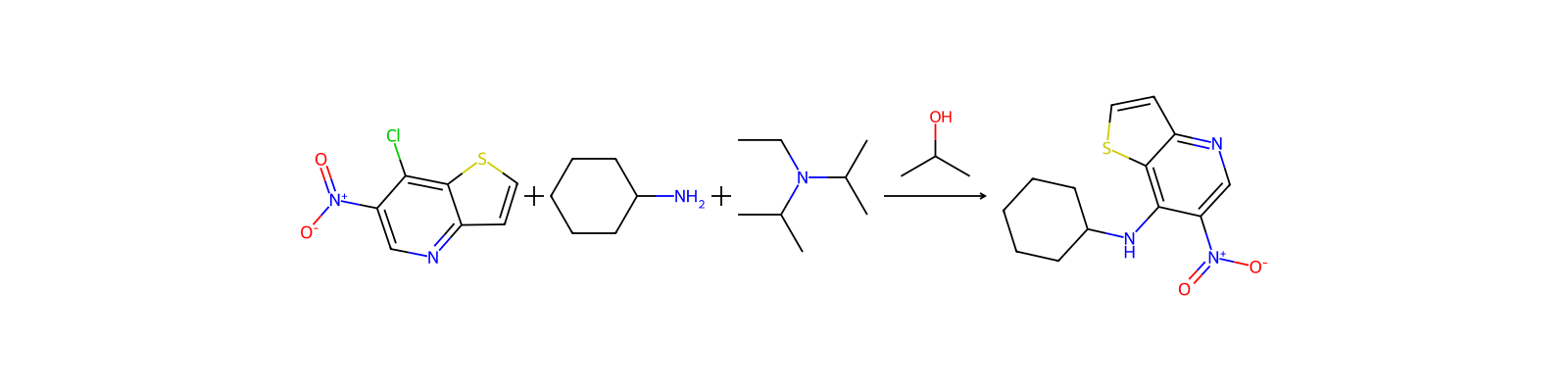
Cl[C:2]1[C:7]([N+:8]([O-:10])=[O:9])=[CH:6][N:5]=[C:4]2[CH:11]=[CH:12][S:13][C:3]=12.[CH:14]1([NH2:20])[CH2:19][CH2:18][CH2:17][CH2:16][CH2:15]1.C(N(CC)C(C)C)(C)C>C(O)(C)C>[CH:14]1([NH:20][C:2]2[C:7]([N+:8]([O-:10])=[O:9])=[CH:6][N:5]=[C:4]3[CH:11]=[CH:12][S:13][C:3]=23)[CH2:19][CH2:18][CH2:17][CH2:16][CH2:15]1Participants
5
Reactant 3



Product 1

Reagents, catalysts & solvents 1

Conditions
- Temperature
- 90 °C
Procedure
A mixture of 7-chloro-6-nitrothieno[3,2-b]pyridine (0.055 g, 0.26 mmol) (Example 1, Step 2), cyclohexanamine (59 μL, 0.51 mmol) and N,N-diisopropylethylamine (0.13 mL, 0.77 mmol) in isopropyl alcohol (0.87 mL) was heated at 90° C. for 2 h. The resulting mixture was concentrated to give the desired product, which was used directly in the next step. LCMS calculated for C13H16N3O2S (M+H)+: m/z=278.1. Found: 278.0.
Workup
- concentrationThe resulting mixture was concentrated
Sources & evidence
- ORD record
- ord-7ed188127f9d4a0ba5689e8aabd17073
- Source dataset
- uspto-grants-2015_11
- Patent number
- US09181271B2
Reaction notes
Loading…