Pyrazole → 7-chloro-5-(1H-pyrazol-1-yl)[1,2,4]triazolo[1,5-a]pyridin-2-amine
Reaction equation

Cl[C:2]1[N:7]2[N:8]=[C:9]([NH2:11])[N:10]=[C:6]2[CH:5]=[C:4]([Cl:12])[CH:3]=1.C(=O)([O-])[O-].[Cs+].[Cs+].[NH:19]1[CH:23]=[CH:22][CH:21]=[N:20]1>CN(C=O)C>[Cl:12][C:4]1[CH:3]=[C:2]([N:19]2[CH:23]=[CH:22][CH:21]=[N:20]2)[N:7]2[N:8]=[C:9]([NH2:11])[N:10]=[C:6]2[CH:5]=1Participants
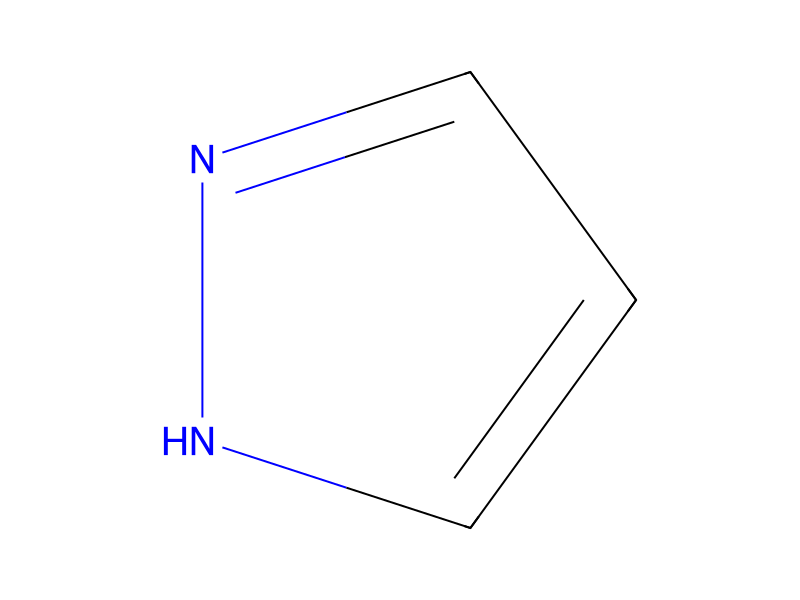




Conditions
- Temperature
- 70 °C
Procedure
5,7-Dichloro[1,2,4]triazolo[1,5-a]pyridin-2-amine (Intermediate 15) (0.5 g, 2.46 mmol), cesium carbonate (1.6 g, 4.93 mmol) and pyrazole (0.5 g, 7.39 mmol) was suspended in DMF (10 mL) and stirred at 70° C. for 2 h after which time LCMS showed desired product formation. The reaction mixture was filtered through celite, which was washed with further DMF and the resultant green/brown solution was concentrated in vacuo to give a brown residue, which was partitioned between 10% IPA/DCM (20 mL) and water (10 mL), the organic layer was separated and the aqueous extracted with further 10% IPA/DCM (2×10 mL). The organic layers were combined and dried (MgSO4), filtered and concentrated in vacuo to give the desired product as a brown solid (0.4 g, 69%). 1H NMR (DMSO) δ 9.16 (d, J=2.6 Hz, 1H), 7.99 (d, J=1.4 Hz, 1H), 7.54 (d, J=2.1 Hz, 1H), 7.36 (d, J=2.1 Hz, 1H), 6.72 (dd, J=2.4, 1.9 Hz, 1H), 6.46 (s, 2H). MS: 235.12 [M+H]+.
Sources & evidence
- ORD record
- ord-645c1f9aa05e4265a55b432c37aca43b
- Source dataset
- uspto-grants-2015_11
- Patent number
- US09181234B2
Reaction notes
Loading…