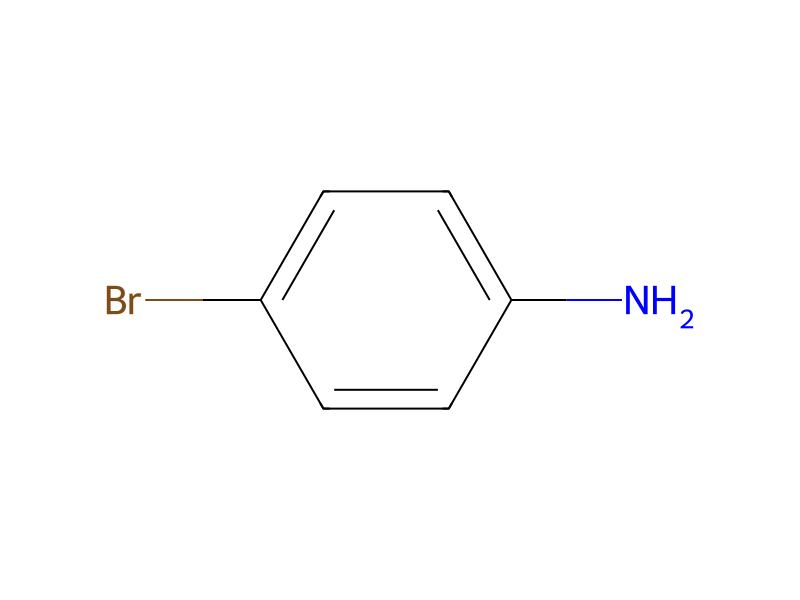
4-Bromoaniline → N-(4-Bromophenyl)-1-azabicyclo[2.2.2]octane-3-carboxamide Hydrochloride
Reaction equation

Cl.[N:2]12[CH2:9][CH2:8][CH:5]([CH2:6][CH2:7]1)[CH:4]([C:10]([Cl:12])=[O:11])[CH2:3]2.[Br:13][C:14]1[CH:20]=[CH:19][C:17]([NH2:18])=[CH:16][CH:15]=1.C(N(CC)C(C)C)(C)C>CN(C=O)C>[ClH:12].[Br:13][C:14]1[CH:20]=[CH:19][C:17]([NH:18][C:10]([CH:4]2[CH:5]3[CH2:8][CH2:9][N:2]([CH2:7][CH2:6]3)[CH2:3]2)=[O:11])=[CH:16][CH:15]=1Participants
5




Procedure
1.00 g (4.76 mmol) of 3-quinuclidinecarbonyl chloride hydrochloride is added at 0° C. to a solution of 900 mg (5.24 mmol) of 4-bromoaniline and 1.85 g (14.28 mmol) of N,N-diisopropylethylamine in about 10 ml of dry DMF. The mixture is stirred at room temperature overnight. Purification by preparative HPLC is followed by chromatography again on silica gel (mobile phase: dichloromethane/methanol/triethylamine 80:20:2). The product is dissolved in methanol and mixed with 1N HCl in methanol. Finally, the solvent is removed. 0.63 g (31% of theory) of the title compound is obtained. The raw material is employed directly in the next synthesis.
Workup
- customPurification by preparative HPLC
- dissolutionThe product is dissolved in methanol
- additionmixed with 1N HCl in methanol
- customFinally, the solvent is removed
Sources & evidence
- ORD record
- ord-9f4d5a6b4afb456992704462bf22b72b
- Source dataset
- uspto-grants-2006_11
- Patent number
- US07138410B2
Reaction notes
Loading…