Triethylamine → 2-Methyl-3-(4,4,5,5-tetramethyl-[1,3,2]dioxaborolan-2-yl)-benzoic acid isopropyl ester
Reaction equation

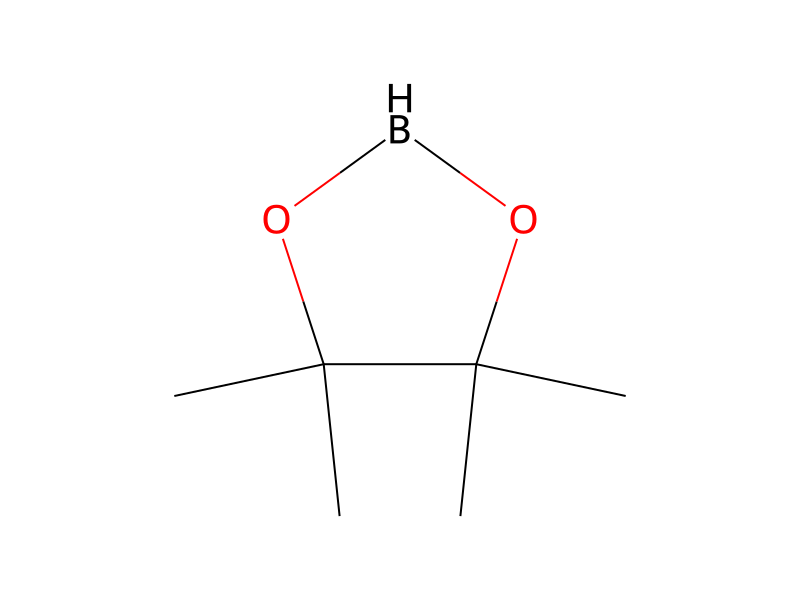
[CH:1]([O:4][C:5](=[O:14])[C:6]1[CH:11]=[CH:10][CH:9]=[C:8](Br)[C:7]=1[CH3:13])([CH3:3])[CH3:2].O1CCOCC1.C(N(CC)CC)C.[CH3:28][C:29]1([CH3:36])[C:33]([CH3:35])([CH3:34])[O:32][BH:31][O:30]1>Cl[Pd](Cl)([P](C1C=CC=CC=1)(C1C=CC=CC=1)C1C=CC=CC=1)[P](C1C=CC=CC=1)(C1C=CC=CC=1)C1C=CC=CC=1.O.CCOC(C)=O>[CH:1]([O:4][C:5](=[O:14])[C:6]1[CH:11]=[CH:10][CH:9]=[C:8]([B:31]2[O:32][C:33]([CH3:35])([CH3:34])[C:29]([CH3:36])([CH3:28])[O:30]2)[C:7]=1[CH3:13])([CH3:3])[CH3:2]Participants
Reactant 4



Product 1

Reagents, catalysts & solvents 3



Conditions
- Temperature
- 100 °C
Procedure
A 2-dram vial with a septa-containing screwcap was charged with a stirbar, 3-bromo-2-methyl-benzoic acid isopropyl ester ((Example 3: step a) 257 mg, 1 mmol), PdCl2(PPh3)2 (42 mg, 0.06 mmol), dioxane (4 mL), and triethylamine (420 μL, 3 mmol). Upon dissolution, 4,4,5,5-tetramethyl-[1,3,2]dioxaborolane (220 μL, 1.5 mmol) was added and the solution was vigorously stirred for 16 h at 100° C. After cooling to rt, EtOAc (30 mL) and water (10 mL) were added (gas evolution!) and the layers were separated. The organic layer was washed with NaHCO3 (2×10 mL), brine (10 mL), and was dried over sodium sulfate. Removal of the solvents in vacuo followed by SiO2 flash chromatography of the residue yielded the title compound (130 mg, 43%) as a light-yellow glass. 1H-NMR (CDCl3): δ 7.86 (dd, 1H, J=1.4, 7.4 Hz), 7.80 (dd, 1H, J=1.6, 7.7 Hz), 7.23 (t, 1H, J=7.7 Hz), 5.26 (heptet, 1H, J=6.3 Hz), 2.75 (s, 3H), 1.37 (m, 18H).
Workup
- additionwas added
- temperatureAfter cooling to rt
- customthe layers were separated
- washThe organic layer was washed with NaHCO3 (2×10 mL), brine (10 mL)
- dry with materialwas dried over sodium sulfate
- customRemoval of the solvents in vacuo
Sources & evidence
- ORD record
- ord-4404ec5564df4f668780db7cf81f6f37
- Source dataset
- uspto-grants-2006_11
- Patent number
- US07138530B2
Reaction notes
Loading…