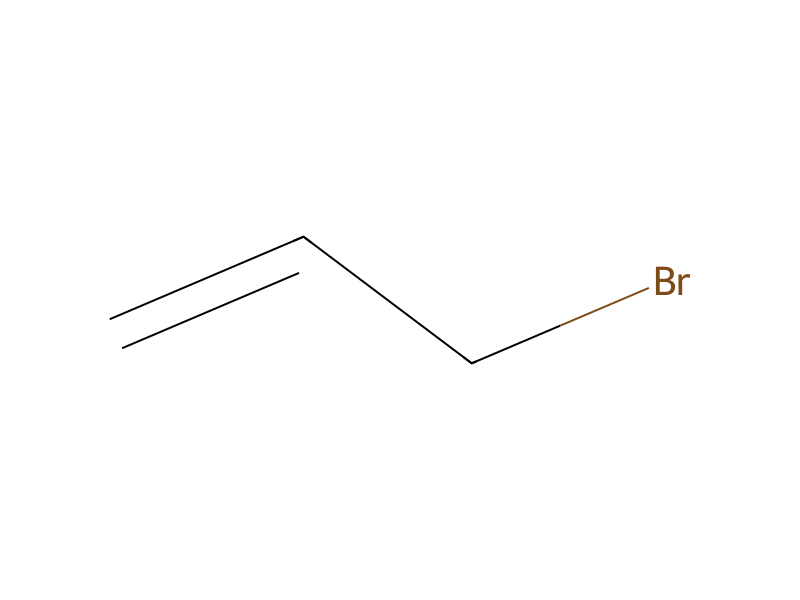
Allyl bromide → HCID 22854038, compound
Reaction equation

[CH3:1][C@:2]12[CH2:19][CH2:18][C@H:17]3[C@@H:7]([CH2:8][CH2:9][C@H:10]4[C@:15]3([CH3:16])[CH2:14][CH2:13][C@H:12](O)[CH2:11]4)[C@@:6]1([OH:21])[CH2:5][CH2:4][CH2:3]2.[H-].[Na+].C(Br)C=C>O1CCCC1>[CH3:1][C@:2]12[CH2:19][CH2:18][C@H:17]3[C@@H:7]([CH2:8][CH2:9][C@H:10]4[C@:15]3([CH3:16])[CH2:14][CH2:13][CH2:12][CH2:11]4)[C@@:6]1([OH:21])[CH2:5][CH2:4][CH2:3]2Participants
Reactant 3


Product 1

Reagents, catalysts & solvents 1

Procedure
To a solution of 6.05 g of 17β-12-(1,3-dioxolanyl)]-5β-androstan-3β,14β-diol in 80 ml of dry tetrahydrofuran. 5.80 g of sodium hydride (60% dispersion in mineral oil) were added under nitrogen atmosphere at room temperature and the resulting mixture was stirred at reflux temperature for 6 hrs. Alter cooling. 18.0 g of allyl bromide were added and the reflux continued for further 20 hrs. The mixture was quenched with water and the organic solvent was distilled under reduced pressure. The residue was extracted with ethyl acetate; the organic solution was dried over anhydrous sodium sulfate and evaporated to dryness. The residue was purified by flash-chromatography using n-hexane/ethyl acetate 80/20 as the eluant to give 5.20 g of 3β-prop-(2-en)oxy-17β-(1,3-dioxolanyl)]-5β-androstan-14β-ol as a white solid.
Workup
- temperatureat reflux temperature for 6 hrs
- temperatureAlter cooling
- customThe mixture was quenched with water
- distillationthe organic solvent was distilled under reduced pressure
- extractionThe residue was extracted with ethyl acetate
- dry with materialthe organic solution was dried over anhydrous sodium sulfate
- customevaporated to dryness
- customThe residue was purified by flash-chromatography
Sources & evidence
- ORD record
- ord-101c7ad61fff41b6a0475424cea7d474
- Source dataset
- uspto-grants-1998_01
- Patent number
- US05705662
Reaction notes
Loading…