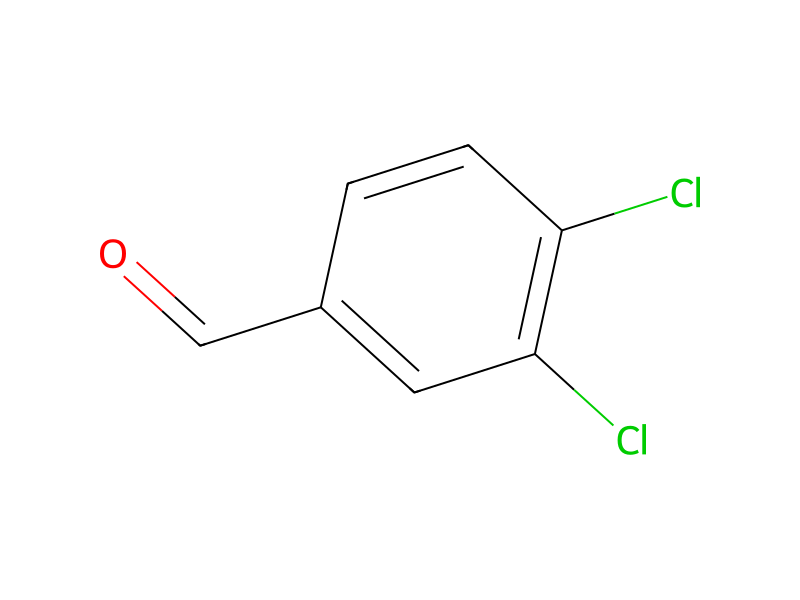
3,4-Dichlorobenzaldehyde → HCID 22101839, compound
Reaction equation

Br[C:2]1[S:3][CH:4]=[CH:5][N:6]=1.C([Li])CCC.[Cl:12][C:13]1[CH:14]=[C:15]([CH:18]=[CH:19][C:20]=1[Cl:21])[CH:16]=[O:17].C(=O)([O-])O.[Na+]>C(OCC)C>[Cl:12][C:13]1[CH:14]=[C:15]([CH:16]([C:4]2[S:3][CH:2]=[N:6][CH:5]=2)[OH:17])[CH:18]=[CH:19][C:20]=1[Cl:21]Participants
Reactant 4



Product 1

Reagents, catalysts & solvents 1

Conditions
- Temperature
- 0 °C
Procedure
2-Bromothiazole (5 g) in dry diethyl ether (20 ml) was added dropwise to a stirred solution of n-butyllithium (1.6M in hexanes, 21 ml) in diethyl ether (20 ml) at -70° C. under an atmosphere of dry nitrogen. After 30 minutes, trimethylsilylchlorlde (3.9 ml) was added and the mixture was allowed to warm to 0° C. The mixture was then cooled to -70° C. and further n-butyllithium (21 ml) was added. The mixture was warmed to 0° C. and after 30 minutes was cooled again to -70° C. and 3,4-dichlorobenzaldehyde (5.8 g) in diethyl ether (40 ml) was added. The mixture was then allowed to warm to room temperature and after 30 minutes saturated aqueous sodium hydrogen carbonate was added. The mixture was extracted with dichloromethane and the material thus obtained was purified by chromatography on silica gel to give the title compound. The hydrochloride salt was prepared. M.p. 167°-170° C.
Workup
- additiontrimethylsilylchlorlde (3.9 ml) was added
- temperatureThe mixture was then cooled to -70° C.
- temperatureThe mixture was warmed to 0° C. and after 30 minutes
- temperaturewas cooled again to -70° C.
- additionwas added
- extractionThe mixture was extracted with dichloromethane
- customthe material thus obtained
- customwas purified by chromatography on silica gel
Sources & evidence
- ORD record
- ord-d59c97b7719a48c5ae33033070e6000f
- Source dataset
- uspto-grants-1998_01
- Patent number
- US05712299
Reaction notes
Loading…