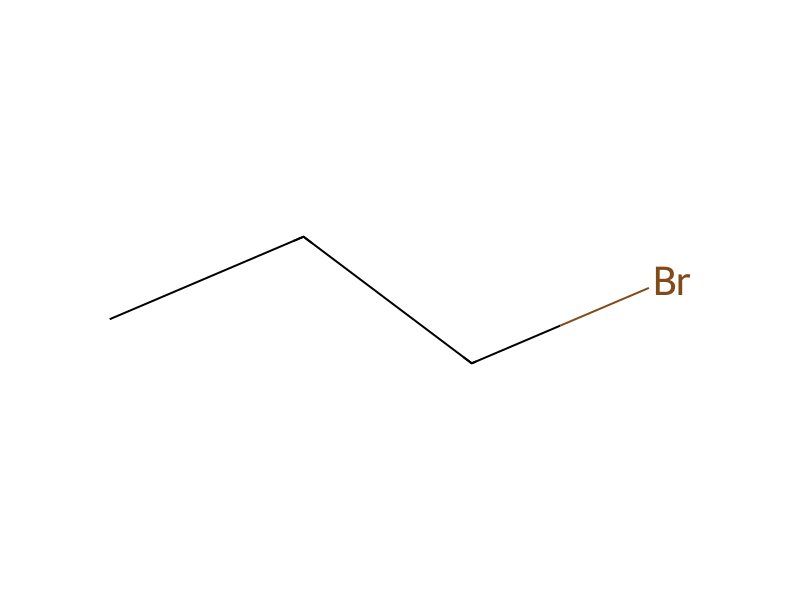
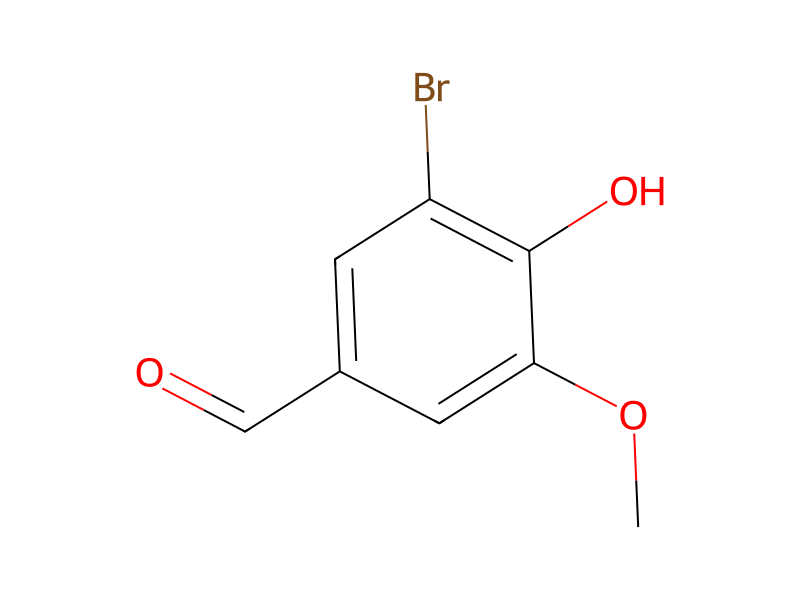
1-Bromopropane → 3-bromo-5-methoxy-4-propoxybenzaldehyde
Reaction equation

[Br:1][C:2]1[C:3]([OH:12])=[C:4]([O:10][CH3:11])[CH:5]=[C:6]([CH:9]=1)[CH:7]=[O:8].C(=O)([O-])[O-].[K+].[K+].Br[CH2:20][CH2:21][CH3:22]>CN(C=O)C>[Br:1][C:2]1[CH:9]=[C:6]([CH:5]=[C:4]([O:10][CH3:11])[C:3]=1[O:12][CH2:20][CH2:21][CH3:22])[CH:7]=[O:8]Participants
5
Reactant 3

Product 1

Reagents, catalysts & solvents 1

Conditions
- Temperature
- 70 °C
Procedure
50 g (0.43 mole) of 5-bromovanillin in 130 ml of DMF was added 150 g (1.08 mole) of potassium carbonate and 55 ml (0.606 mole) of bromopropane. The mixture was stirred for 72 hours at 70° C. The solution was then poured into 1 liter ice water. The aqueous solution was extracted with 3×200 ml CH2Cl2, the combined organic extracts were dried over MgSO4. The solution was filtered and the filtrate was concentrated to dryness to yield 66.80 g of 3-bromo-5-methoxy-4-propoxybenzaldehyde as a yellow oil. (95% yield).
Workup
- extractionThe aqueous solution was extracted with 3×200 ml CH2Cl2
- dry with materialthe combined organic extracts were dried over MgSO4
- filtrationThe solution was filtered
- concentrationthe filtrate was concentrated to dryness
Sources & evidence
- ORD record
- ord-a915c6b48a92425194dfce06e1e3dbd3
- Source dataset
- uspto-grants-1991_09
- Patent number
- US05047420
Reaction notes
Loading…