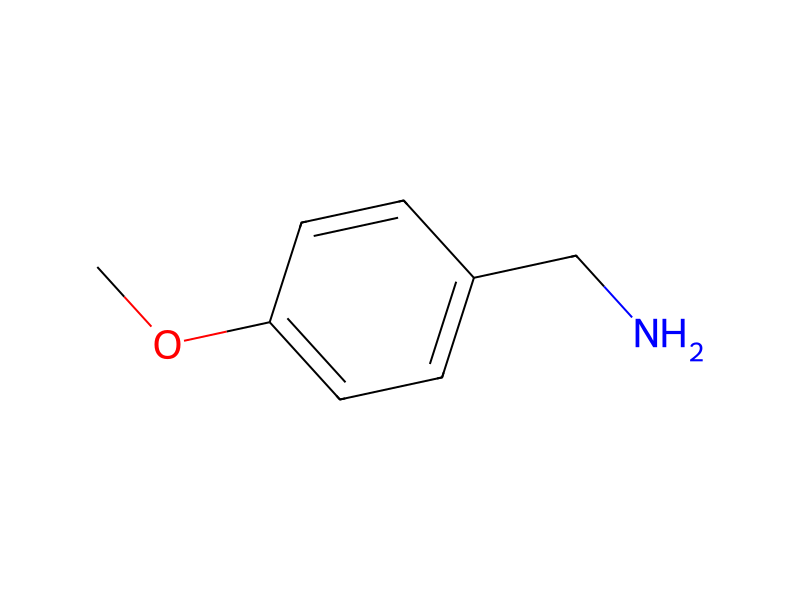
4-Methoxybenzylamine → N2-(4-Methoxy-benzyl)-6-trifluoromethyl-pyridine-2,3-diamine
Reaction equation

[NH2:1][C:2]1[C:3](Cl)=[N:4][C:5]([C:8]([F:11])([F:10])[F:9])=[CH:6][CH:7]=1.[CH3:13][O:14][C:15]1[CH:22]=[CH:21][C:18]([CH2:19][NH2:20])=[CH:17][CH:16]=1.C(=O)(O)[O-].[Na+]>C(O)CC(C)C.CO>[CH3:13][O:14][C:15]1[CH:22]=[CH:21][C:18]([CH2:19][NH:20][C:3]2[C:2]([NH2:1])=[CH:7][CH:6]=[C:5]([C:8]([F:11])([F:10])[F:9])[N:4]=2)=[CH:17][CH:16]=1Participants
6





Conditions
- Temperature
- 220 °C
Procedure
A mixture of the 3-amino-2-chloro-6-(trifluoromethyl)pyridine (416 mg, 2.1 mmol, Matrix), 4-methoxy-benzylamine (294 mg, 2.1 mmol, Aldrich) and sodium bicarbonate (265 mg, 3.2 mmol) in isoamyl alcohol (0.6 mL) was heated at 220° C. in a microwave synthesizer for 30 min. The reaction mixture was then cooled to room temperature, diluted with MeOH (5 mL), filtered and the filtrate was evaporated in vacuo. The residue was purified by preparative HPLC (gradient 0.1% trifluoroacetic acid in acetonitrile) to give the title compound as a yellow oil. MS (ESI, pos. ion) m/z: 298 (M+1)
Workup
- temperatureThe reaction mixture was then cooled to room temperature
- filtrationfiltered
- customthe filtrate was evaporated in vacuo
- customThe residue was purified by preparative HPLC (gradient 0.1% trifluoroacetic acid in acetonitrile)
Sources & evidence
- ORD record
- ord-a9c6f196224943bcb39b798019d721b8
- Source dataset
- uspto-grants-2009_09
- Patent number
- US07582761B2
Reaction notes
Loading…