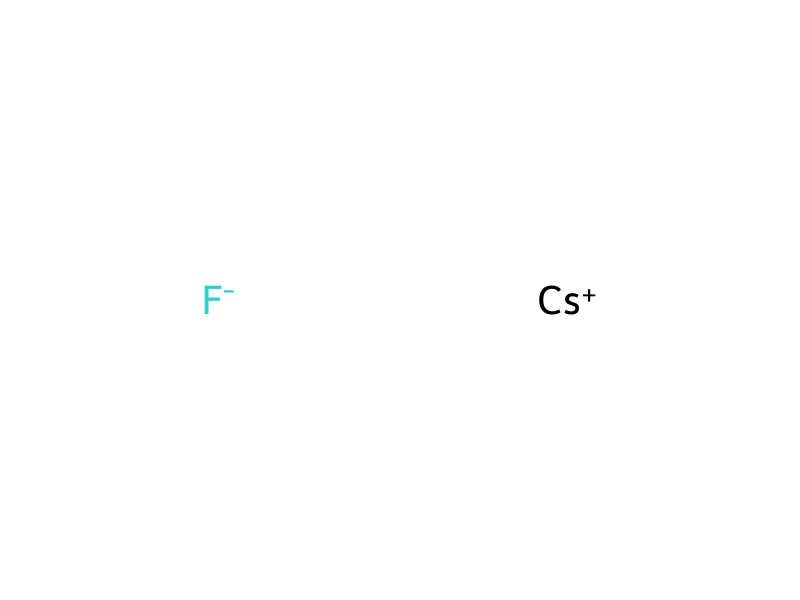
Cesium fluoride → 1-(2-{4-[6-Benzyloxy-2-(4-trifluoromethanesulfonyl-phenyl)-benzo[b]thiophen-3-yloxy]-phenoxy}-ethyl)-piperidine
Reaction equation

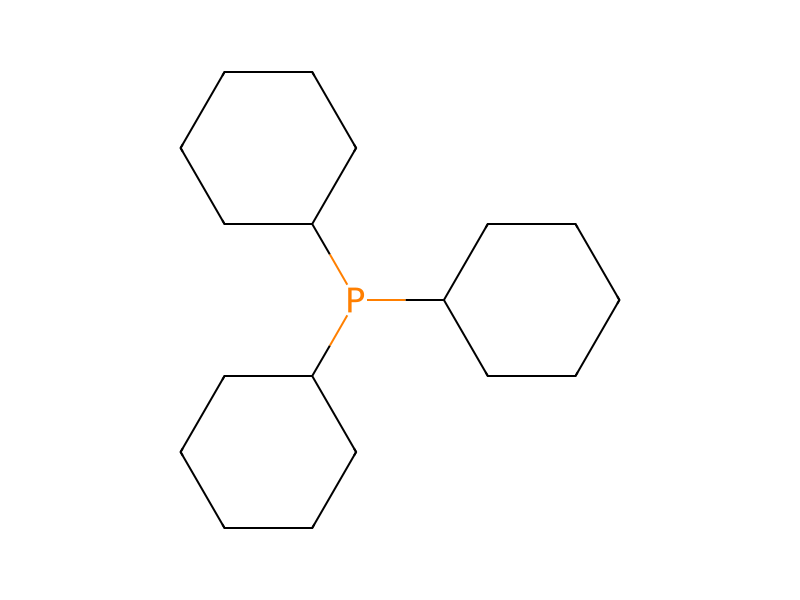
C1(P(C2CCCCC2)C2CCCCC2)CCCCC1.[CH2:20]([O:27][C:28]1[CH:29]=[CH:30][C:31]2[C:35]([O:36][C:37]3[CH:51]=[CH:50][C:40]([O:41][CH2:42][CH2:43][N:44]4[CH2:49][CH2:48][CH2:47][CH2:46][CH2:45]4)=[CH:39][CH:38]=3)=[C:34](Br)[S:33][C:32]=2[CH:53]=1)[C:21]1[CH:26]=[CH:25][CH:24]=[CH:23][CH:22]=1.CC1(C)C(C)(C)OB([C:62]2[CH:67]=[CH:66][C:65]([S:68]([C:71]([F:74])([F:73])[F:72])(=[O:70])=[O:69])=[CH:64][CH:63]=2)O1.[F-].[Cs+]>C(#N)C.C([O-])(=O)C.[Pd+2].C([O-])(=O)C>[CH2:20]([O:27][C:28]1[CH:29]=[CH:30][C:31]2[C:35]([O:36][C:37]3[CH:51]=[CH:50][C:40]([O:41][CH2:42][CH2:43][N:44]4[CH2:49][CH2:48][CH2:47][CH2:46][CH2:45]4)=[CH:39][CH:38]=3)=[C:34]([C:62]3[CH:63]=[CH:64][C:65]([S:68]([C:71]([F:73])([F:72])[F:74])(=[O:70])=[O:69])=[CH:66][CH:67]=3)[S:33][C:32]=2[CH:53]=1)[C:21]1[CH:26]=[CH:25][CH:24]=[CH:23][CH:22]=1Participants
Reactant 4


Product 1

Reagents, catalysts & solvents 2


Conditions
- Temperature
- 90 °C
Procedure
Sonicate a suspension of palladium (II) acetate (146 mg, 0.65 mmol) and tricyclohexylphosphine (273 mg, 0.98 mmol) in acetonitrile (4 mL) for 10 minutes. In a separate flask, add a solution of 1-{2-[4-(6-benzyloxy-2-bromo-benzo[b]thiophen-3-yloxy)-phenoxy]-ethyl}-piperidine (350 mg, 0.65 mmol) and 4,4,5,5-tetramethyl-2-(4-trifluoromethanesulfonyl-phenyl)-[1,3,2]dioxaborolane (531 mg, 2.0 mmol) in acetonitrile (9 mL) to cesium fluoride (889 mg, 5.9 mmol). Add the sonicated catalyst mixture, and heat to 90° C. for 2 hours. Concentrate in vacuo and partition the residue between ethyl acetate (20 mL) and saturated aqueous sodium bicarbonate (20 mL). Combine the organic layer with saturated aqueous ammonium chloride (20 mL) and filter. Wash the organic layer with brine (20 mL), dry with sodium sulfate, and concentrate in vacuo. Chromatbgraph the residue on a SiO2 column eluting with methanol in dichloromethane (0 to 3%) to give 240 mg of the title compound (55%) contaminated with tricyclohexylphosphine oxide. 1H NMR (CDCl3): δ 8.03-7.95 (m, 4H), 7.45-7.33 (m, 5H), 7.32 (d, J=2.3 Hz, 1H), 7.29 (d, J=8.9 Hz, 1H), 6.96 (dd, J=9.0, 2.2 Hz, 1H), 6.89-6.79 (m, 4H), 5.13 (s, 2H), 4.03 (t, J=6.0 Hz, 2H), 2.73 (t, J=6.0 Hz, 2H), 2.48 (bs, 4H), 1.96-1.18 (complex multiplet obscured by P(O)Cy3, 6H).
Workup
- customSonicate
- additionAdd the sonicated catalyst mixture
- concentrationConcentrate in vacuo
- custompartition the residue between ethyl acetate (20 mL) and saturated aqueous sodium bicarbonate (20 mL)
- filtrationCombine the organic layer with saturated aqueous ammonium chloride (20 mL) and filter
- washWash the organic layer with brine (20 mL)
- dry with materialdry with sodium sulfate
- concentrationconcentrate in vacuo
- washChromatbgraph the residue on a SiO2 column eluting with methanol in dichloromethane (0 to 3%)
Sources & evidence
- ORD record
- ord-4d82703704a7446ea60ab1737cd98d33
- Source dataset
- uspto-grants-2009_09
- Patent number
- US07585977B2
Reaction notes
Loading…