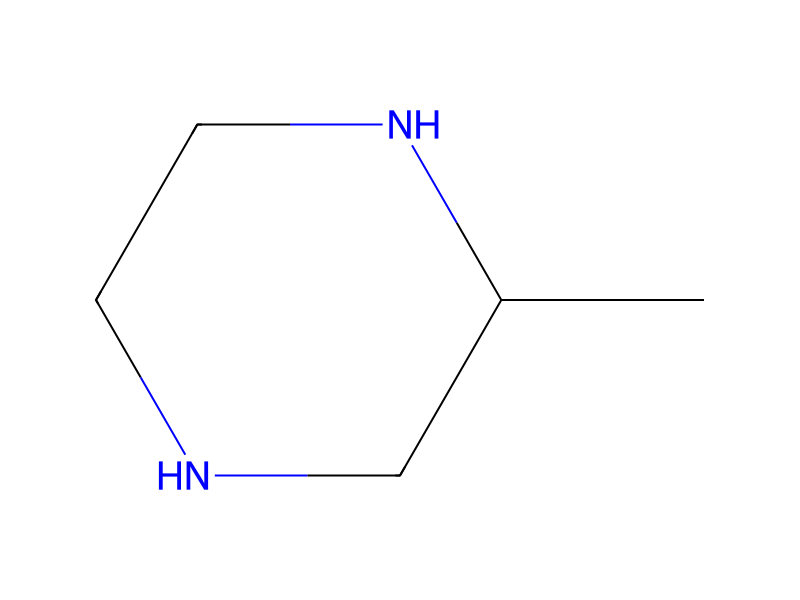
2-Methylpiperazine → HCID 178430318, compound
Reaction equation

[CH3:1][CH:2]1[CH2:7][NH:6][CH2:5][CH2:4][NH:3]1.Cl[CH2:9][C:10]1[CH:44]=[CH:43][C:13]([C:14]([NH:16][C:17]2[C:18]3[CH:31]=[C:30]([C:32]([NH:34][N:35]([CH3:42])[C:36]4[CH:41]=[CH:40][CH:39]=[CH:38][CH:37]=4)=[O:33])[S:29][C:19]=3[N:20](C(OC(C)(C)C)=O)[N:21]=2)=[O:15])=[CH:12][CH:11]=1.ClCC1C=CC(C(NC2C3C=C(C(NN(C4C=CC(Cl)=CC=4)C)=O)SC=3N(C(OC(C)(C)C)=O)N=2)=O)=CC=1>[I-].C([N+](CCCC)(CCCC)CCCC)CCC.CN(C)C=O>[CH3:42][N:35]([C:36]1[CH:41]=[CH:40][CH:39]=[CH:38][CH:37]=1)[NH:34][C:32]([C:30]1[S:29][C:19]2[NH:20][N:21]=[C:17]([NH:16][C:14](=[O:15])[C:13]3[CH:43]=[CH:44][C:10]([CH2:9][N:6]4[CH2:5][CH2:4][NH:3][CH:2]([CH3:1])[CH2:7]4)=[CH:11][CH:12]=3)[C:18]=2[CH:31]=1)=[O:33]Participants



Conditions
- Temperature
- 25 °C
Procedure
27 mg (74 μmol) of tetrabutylammonium iodide, followed by 111 mg (1.11 mmol) of 2-methylpiperazine, are added to a solution of 200 mg (0.37 mmol) of an approximately 70:30 mixture of tert-butyl 3-(4-chloromethylbenzoylamino)-5-(N′-methyl-N′-phenylhydrazinocarbonyl)thieno[2,3-c]pyrazole-1-carboxylate and tert-butyl 3-(4-chloromethylbenzoylamino)-5-(N′-(4-chlorophenyl)-N′-methylhydrazinocarbonyl)thieno[2,3-c]pyrazole-1-carboxylate in 6 mL of dimethylformamide under argon. The reaction mixture is stirred at a temperature in the region of 25° C. for 16 hours, and then treated with ice. It is then extracted with ethyl acetate and then twice with dichloromethane. The organic extracts are combined and then concentrated to dryness under vacuum (2 kPa) at a temperature in the region of 40° C. The residue is dissolved in 3 mL of methanol and the solution is introduced into a microwave oven tube. The tube is stoppered and the reaction mixture is irradiated at a temperature in the region of 100° C. for 30 minutes. The reaction mixture is then concentrated to dryness under vacuum (2 kPa) at a temperature in the region of 40° C. The residue is purified by chromatography on a cartridge of 12 g of silica gel (0.035-0.060 mm), eluting first with a gradient of a dichloromethane/methanol mixture (100/0 to 98/2 by volume), and then with a dichloromethane/methanol/28% aqueous ammonia mixture (12/3/0.5 by volume) at a flow rate of 20 mL/min. The fractions containing the expected product are combined and then concentrated to dryness under reduced pressure (2 kPa) at a temperature in the region of 40° C. The residue is purified by preparative LC/MS (conditions B). 85 mg of N-[5-(N′-methyl-N′-phenylhydrazinocarbonyl)-1H-thieno[2,3-c]pyrazol-3-yl]-4-(3-methylpiperazin-1-ylmethyl)benzamide are thus obtained in the form of a yellow powder melting from 176 to 186° C. LC-MS-DAD-ELSD: 504(+)=(M+H)(+).
Workup
- additiontreated with ice
- extractionIt is then extracted with ethyl acetate
- concentrationconcentrated to dryness under vacuum (2 kPa) at a temperature in the region of 40° C
- dissolutionThe residue is dissolved in 3 mL of methanol
- additionthe solution is introduced into a microwave oven tube
- customthe reaction mixture is irradiated at a temperature in the region of 100° C. for 30 minutes
- concentrationThe reaction mixture is then concentrated to dryness under vacuum (2 kPa) at a temperature in the region of 40° C
- customThe residue is purified by chromatography on a cartridge of 12 g of silica gel (0.035-0.060 mm)
- washeluting first with a gradient of a dichloromethane/methanol mixture (100/0 to 98/2 by volume)
- additionThe fractions containing the expected product
- concentrationconcentrated to dryness under reduced pressure (2 kPa) at a temperature in the region of 40° C
- customThe residue is purified by preparative LC/MS (conditions B)
Sources & evidence
- ORD record
- ord-dde8c8e62ae3448b9e7a23c39c65aa28
- Source dataset
- uspto-grants-2009_09
- Patent number
- US07595320B2
Reaction notes
Loading…