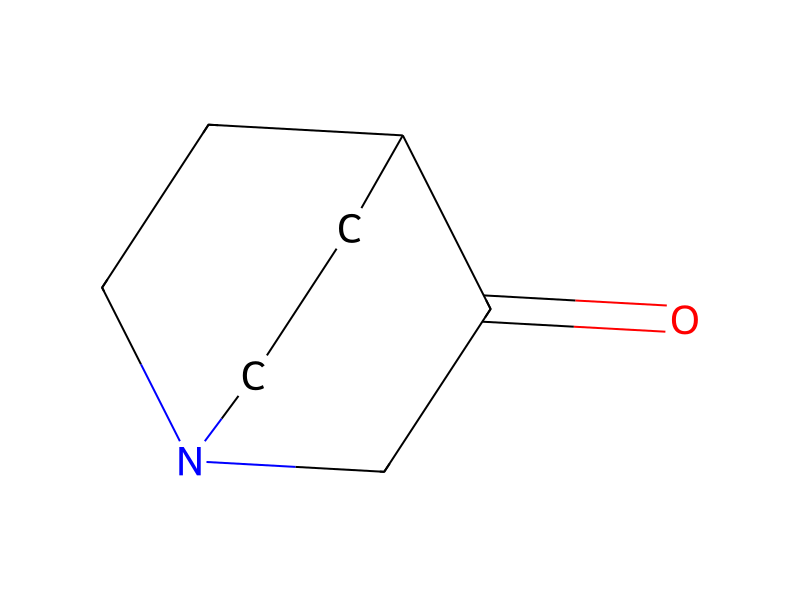
3-Quinuclidinone → HCID 23313737, compound
Reaction equation

[Mg].[Cl:2][C:3]1[CH:8]=[CH:7][C:6]([CH2:9][CH2:10]Br)=[CH:5][CH:4]=1.[N:12]12[CH2:19][CH2:18][CH:15]([CH2:16][CH2:17]1)[C:14](=[O:20])[CH2:13]2>O1CCCC1>[ClH:2].[Cl:2][C:3]1[CH:8]=[CH:7][C:6]([CH2:9][CH2:10][C:14]2([OH:20])[CH:15]3[CH2:18][CH2:19][N:12]([CH2:17][CH2:16]3)[CH2:13]2)=[CH:5][CH:4]=1Participants
Reactant 3


Product 1

Reagents, catalysts & solvents 1

Procedure
To 2.43 g (0.10 mole) of magnesium in 30 ml of anhydrous tetrahydrofuran under an N2 atmosphere is added slowly 21.95 g (0.10 mole) of 2-(4-chlorophenyl)ethyl bromide. The addition rate is such that a gentle reflux of the solvent is maintained. After the addition is complete the mixture is refluxed until the magnesium metal is thoroughly reacted. Cool the reaction mixture to 40°-45° C. and add a solution of 12.52 g (0.1 mole) of 3-quinuclidinone in 100 ml of anhydrous tetrahydrofuran at a sufficient rate to bring the mixture to a gentle reflux. When the addition is complete reflux the mixture for 1 hour. Follow the progress of the reaction by thin-layer chromatography on silica gel (acetonitrile: ammonium hydroxide, 95:5). At the completion of the reaction cool the mixture to 0°-5° C. in an ice/water bath. Quench the reaction mixture by the slow addition of 20 ml of 10% hydrochloric acid solution. Remove the tetrahydrofuran in vacuo. Add 100 ml of water to the residue then add sufficient 10% sodium hydroxide with cooling to bring the pH of the mixture to 11-12. Remove any magnesium hydroxide which may have precipitated by filtration, then wash the filtered solids with methylene chloride. Extract the aqueous base mixture with three 150 ml portions of methylene chloride. Combine all methylene chloride extracts and wash them with 75 ml of water followed by 75 ml of saturated sodium chloride solution. Dry the methylene chloride solution over anhydrous sodium sulfate. Remove the drying agent by filtration and strip the solvent in vacuo to provide the title compound as the free base.
Workup
- temperaturea gentle reflux of the solvent
- temperatureis maintained
- additionAfter the addition
- customis thoroughly reacted
- temperatureCool the reaction mixture to 40°-45° C.
- additionWhen the addition
- temperatureis complete reflux the mixture for 1 hour
- customthe progress of the reaction by thin-layer chromatography on silica gel (acetonitrile: ammonium hydroxide, 95:5)
- temperatureAt the completion of the reaction cool the mixture to 0°-5° C. in an ice/water bath
- customQuench the reaction mixture
- additionby the slow addition of 20 ml of 10% hydrochloric acid solution
- customRemove the tetrahydrofuran in vacuo
- additionAdd 100 ml of water to the residue
- additionthen add sufficient 10% sodium hydroxide
- temperaturewith cooling
- customRemove any magnesium hydroxide which
- custommay have precipitated by filtration
- washwash the filtered solids with methylene chloride
- extractionExtract the aqueous base mixture with three 150 ml portions of methylene chloride
- washwash them with 75 ml of water
- dry with materialDry the methylene chloride solution over anhydrous sodium sulfate
- customRemove the drying agent
- filtrationby filtration and strip the solvent in vacuo
Sources & evidence
- ORD record
- ord-a02883aad14348be9a09cb5482b00952
- Source dataset
- uspto-grants-1986_07
- Patent number
- US04599344
Reaction notes
Loading…