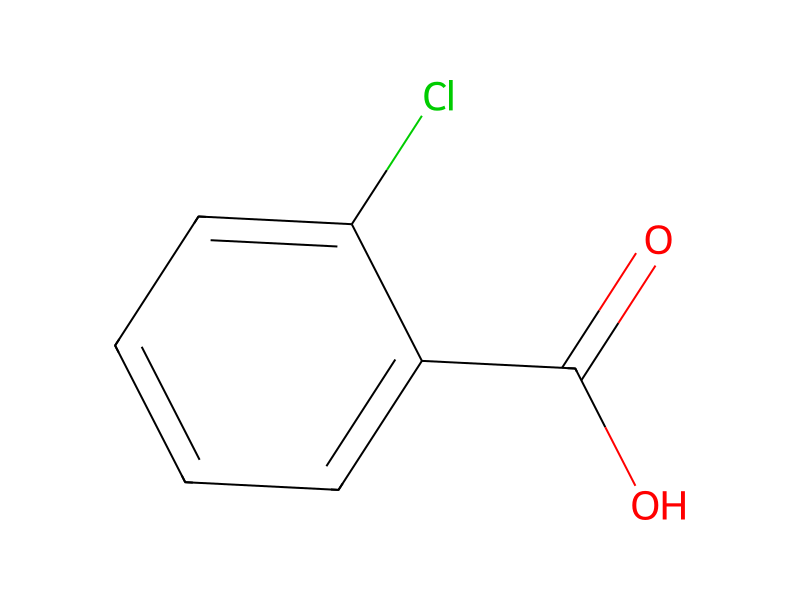
Acetic Acid → 2-Chlorobenzoic Acid
Reaction equation

[Cl:1][C:2]1C=[CH:6][CH:5]=[CH:4][C:3]=1C.[C:9]([OH:12])(=[O:11])[CH3:10]>O.O.O.O.C([O-])(=O)C.[Co+2].C([O-])(=O)C.[Br-].[Na+]>[Cl:1][C:2]1[CH:3]=[CH:4][CH:5]=[CH:6][C:10]=1[C:9]([OH:12])=[O:11]Participants
5
Reactant 2


Product 1
Reagents, catalysts & solvents 2


Conditions
- Temperature
- 25 °C
Procedure
Analogously to Example 1, 300 g of o-chlorotoluene was oxidized in the presence of 100 g of acetic acid, 3 g of cobalt acetate tetrahydrate and 1.5 g of sodium bromide at a pressure of 25 bar, a temperature of 110°-130° C., and a gas exhaust rate of 3 1/min. After the oxidation had ended, 450 g of 50% acetic acid was added, the mixture was cooled to 25° C. and filtered, and the filter cake was washed with 750 g of 50% acetic acid, the mother liquor (314.5 g) and washing filtrates (693.5 g) being recovered separately. The dried filter cake yielded 318.5 g of o-chlorobenzoic acid.
Workup
- customa temperature of 110°-130° C.
- filtrationfiltered
- washthe filter cake was washed with 750 g of 50% acetic acid
- washthe mother liquor (314.5 g) and washing filtrates (693.5 g)
- custombeing recovered separately
- filtrationThe dried filter cake
Sources & evidence
- ORD record
- ord-88d12c21a8bd4069be1f5b712d78708b
- Source dataset
- uspto-grants-1986_07
- Patent number
- US04603220
Reaction notes
Loading…