Acetone → Sodium Hydroxide
Reaction equation

[S:1]([O-:5])([O-:4])(=[O:3])=[O:2].[OH:6][NH3+:7].O[NH3+].NO.S(=O)(=O)(O)[OH:13].[OH-].[Na+:18].[C:19]1(=O)[CH2:24][CH2:23][CH2:22][CH2:21][CH2:20]1.[CH3:26][C:27]([CH3:29])=O>>[S:1]([OH:5])([OH:4])(=[O:3])=[O:2].[CH:19]1([N:7]([CH:27]([CH3:29])[CH3:26])[OH:6])[CH2:24][CH2:23][CH2:22][CH2:21][CH2:20]1.[CH:19]1([N:7]([CH:27]([CH3:29])[CH3:26])[OH:6])[CH2:24][CH2:23][CH2:22][CH2:21][CH2:20]1.[OH-:13].[Na+:18]Participants





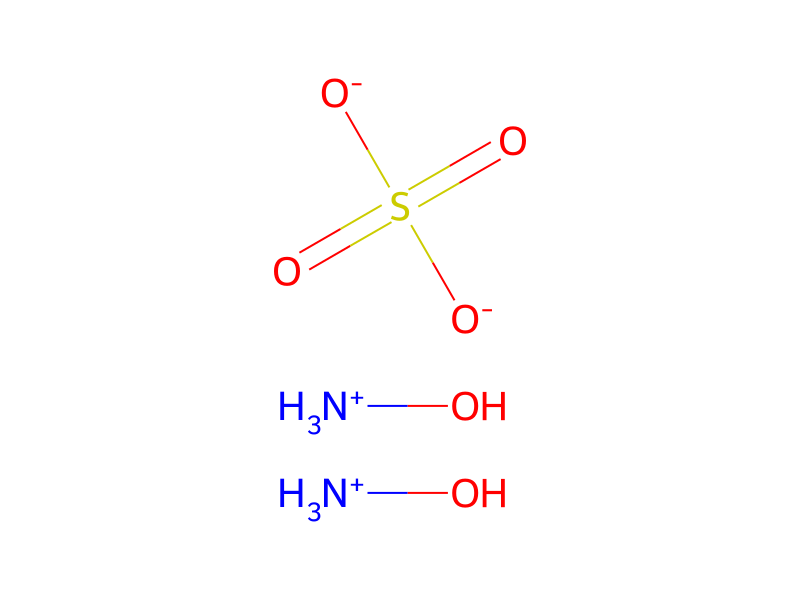

Procedure
An aqueous solution of 1800 g of hydroxylammonium sulfate solution (25% strength) is made up (=5.39 mol of hydroxylamine). 79.0 g of moist hydrogenation catalyst are added thereto. The free sulfuric acid in the solution is partly neutralized by means of 36.7 g of 50% strength sodium hydroxide solution (=0.458 mol) over a period of 2 minutes. While stirring, the mixture is thermostated to 50° C. and 477.9 g (4.87 mol) of cyclohexanone are introduced over a period of 30 minutes by means of a Desaga pump. The reactor is flushed and the hydrogenation is commenced with vigorous stirring. The hydrogen is introduced via the sparging tube during the entire time. After 100% of theory of H2 have been reached, 167 g (2.88 mol) of acetone are fed in at 50° C. Hydrogenation is subsequently continued. Finally, CIPHAS is confirmed as main product. The free hydroxylamine derivative can be obtained by reaction with sodium hydroxide. A work-up is not carried out.
Workup
- customis thermostated to 50° C.
- customThe reactor is flushed
- additionThe hydrogen is introduced via the sparging tube during the entire time
- customare fed in at 50° C
Sources & evidence
- ORD record
- ord-94b626dc3dfb46ddbdf1dab1592e8bda
- Source dataset
- uspto-grants-2008_07
- Patent number
- US07396959B2
Reaction notes
Loading…