Piperazine → 2-(Piperazin-1-yl)-1,3-thiazole-5-carboxylic acid
Reaction equation
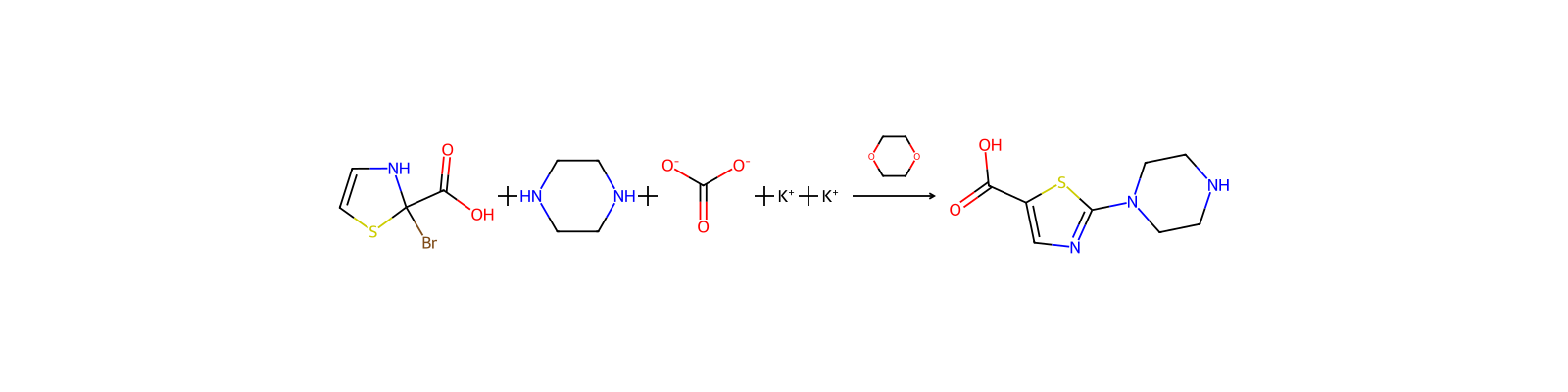
Br[C:2]1(C(O)=O)[NH:6][CH:5]=[CH:4][S:3]1.[NH:10]1[CH2:15][CH2:14][NH:13][CH2:12][CH2:11]1.[C:16]([O-])([O-:18])=[O:17].[K+].[K+]>O1CCOCC1>[N:10]1([C:2]2[S:3][C:4]([C:16]([OH:18])=[O:17])=[CH:5][N:6]=2)[CH2:15][CH2:14][NH:13][CH2:12][CH2:11]1Participants
5
Reactant 3



Product 1

Reagents, catalysts & solvents 1

Procedure
2-Bromothiazole carboxylic acid 1 (1 g; 4.8 mmol) and piperazine (6.2 g; 72 mmol; 24 equiv.) were dissolved in dioxane, K2CO3 (3.32 g; 24 mmol; 5 equiv.) was added and the suspension was refluxed over night. The solvent was removed at the rotary evaporator, the residue dissolved in ethanol, filtered and recrystallized. The crude product was dried at the oil pump and directly used in the following step.
Workup
- temperaturethe suspension was refluxed over night
- customThe solvent was removed at the rotary evaporator
- dissolutionthe residue dissolved in ethanol
- filtrationfiltered
- customrecrystallized
- dry with materialThe crude product was dried at the oil pump
Sources & evidence
- ORD record
- ord-540876f9926548bb87ef494dd0757107
- Source dataset
- uspto-grants-2014_09
- Patent number
- US08846682B2
Reaction notes
Loading…