Bromocyclopentane → 3-Cyclopentyloxy-4-methoxybenzaldehyde
Reaction equation

[OH:1][C:2]1[CH:3]=[C:4]([CH:7]=[CH:8][C:9]=1[O:10][CH3:11])[CH:5]=[O:6].C(=O)([O-])[O-].[K+].[K+].[CH:18]1(Br)[CH2:22][CH2:21][CH2:20][CH2:19]1>CN(C)C=O>[CH:18]1([O:1][C:2]2[CH:3]=[C:4]([CH:7]=[CH:8][C:9]=2[O:10][CH3:11])[CH:5]=[O:6])[CH2:22][CH2:21][CH2:20][CH2:19]1Participants
Reactant 3



Product 1
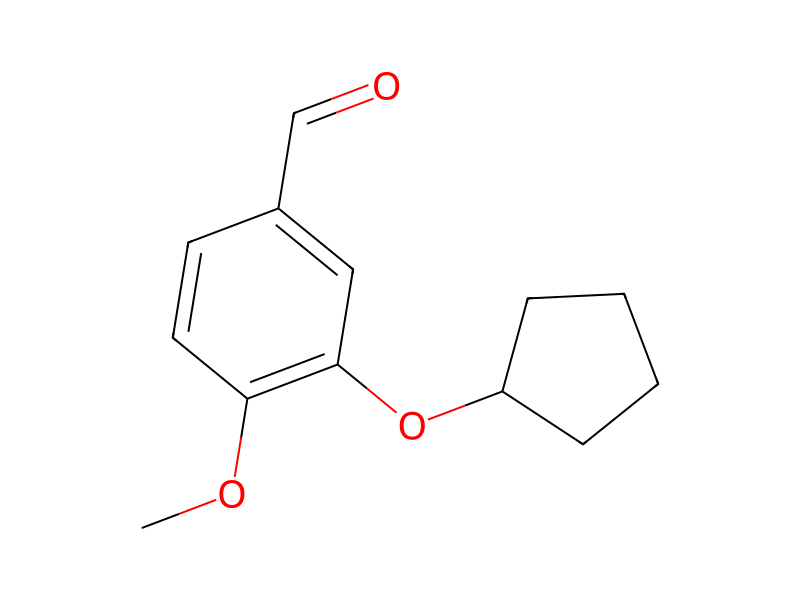
Reagents, catalysts & solvents 1

Conditions
- Temperature
- 100 °C
Procedure
A mixture of 3-hydroxy-4-methoxybenzaldehyde (40 g, 0.26 mol), potassium carbonate (40 g, 0.29 mol) and cyclopentyl bromide (32 ml, 0.31 mol) in dimethylformamide (0.25 l) was heated under an argon atmosphere at 100° C. After 4 hours, additional cyclopentyl bromide (8.5 ml, 0.08 mol) was added and heating was continued for 4 hours. The mixture was allowed to cool and was filtered. The filtrate was concentrated under reduced pressure and the residue was partitioned between ether and aqueous sodium bicarbonate. The organic extract was washed with aqueous sodium carbonate and was dried (potassium carbonate). The solvent was removed in-vacuo and the residue was purified by flash chromatography, eluting with 2:1 hexanes/ether to provide a pale yellow oil (52 g, 89%)[may also be distilled at ˜0.02 mm Hg].
Workup
- temperatureheating
- waitwas continued for 4 hours
- temperatureto cool
- filtrationwas filtered
- concentrationThe filtrate was concentrated under reduced pressure
- customthe residue was partitioned between ether and aqueous sodium bicarbonate
- extractionThe organic extract
- washwas washed with aqueous sodium carbonate
- dry with materialwas dried (potassium carbonate)
- customThe solvent was removed in-vacuo
- customthe residue was purified by flash chromatography
- washeluting with 2:1 hexanes/ether
Sources & evidence
- ORD record
- ord-6f9c4a9f0a3a4bfb9a5c7505e4779307
- Source dataset
- uspto-grants-2002_04
- Patent number
- US06372770B1
Reaction notes
Loading…