Hydrochloric Acid → N-(N-Formyl-L-alpha-aspartyl)-3-phenyl-L-alanine
Reaction equation

[NH2:1][C@H:2]([C:10]([OH:12])=[O:11])[CH2:3][C:4]1[CH:9]=[CH:8][CH:7]=[CH:6][CH:5]=1.[CH:13]([NH:15][C@@H:16]1[C:21](=[O:22])[O:20][C:18](=[O:19])[CH2:17]1)=[O:14].Cl>O>[CH:13]([NH:15][C@H:16]([C:21]([NH:1][C@H:2]([C:10]([OH:12])=[O:11])[CH2:3][C:4]1[CH:9]=[CH:8][CH:7]=[CH:6][CH:5]=1)=[O:22])[CH2:17][C:18](=[O:19])[OH:20])=[O:14]Participants
Reactant 3

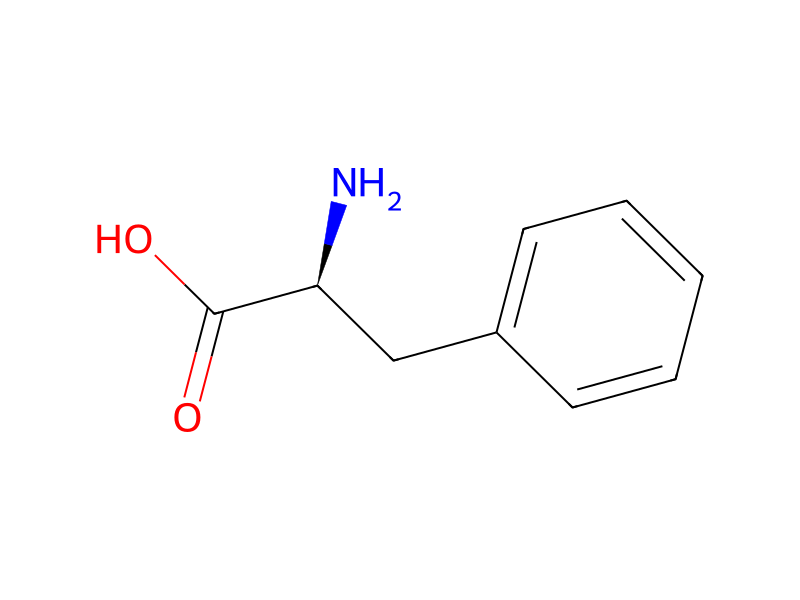

Product 1

Reagents, catalysts & solvents 1

Procedure
To 200 ml of water, 50% caustic solution is added to adjust the pH to 9.5. To the aqueous solution, L-phenylalanine (30 g, 0.181 mole) is dissolved while adding 11.8 ml of 50% caustic solution. After cooling the resultant solution to between -3° C. to +3° C., 14.5 ml of 50% caustic solution and formyl-L-aspartic anhydride (28.6 g, 0.199 mole) is added over a 1 hour period and the resulting reaction mixture is stirred for 1/2 hour at between -3° C. to 3° C. Upon lowering the pH of the mixture using 34.4 ml of hydrogen chloride, a solid precipitate is produced and it is separated by filtration. The precipitate is dried to obtain the desired formyl-α-L-aspartyl-L-phenylalanine (42.6 g, 0.138 mole). The remaining filtrate is collected and acidified to a pH of 6.0 with 9.4 ml of concentrated hydrogen chloride to produce the precipitate. The precipitate is filtered and dried to obtain additional formyl-α-L-aspartyl-L-phenylalanine (2.9 g, 0.009 mole). TLC analysis shows that there is no trace of β-isomer.
Workup
- additionis added over a 1 hour period
- customthe resulting reaction mixture
- customa solid precipitate is produced
- customit is separated by filtration
- customThe precipitate is dried
Sources & evidence
- ORD record
- ord-4a1078fdfab04c80b0a39b8a5d1d9fd5
- Source dataset
- uspto-grants-1988_07
- Patent number
- US04760164
Reaction notes
Loading…