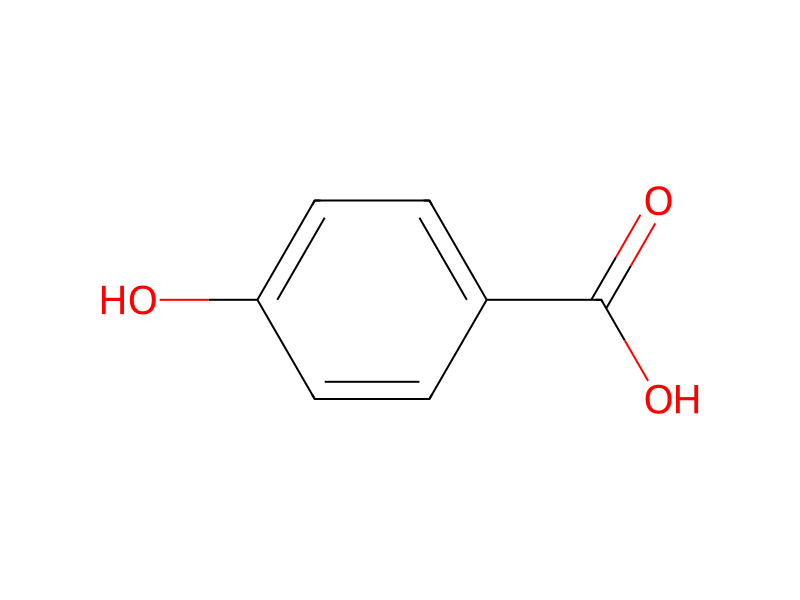
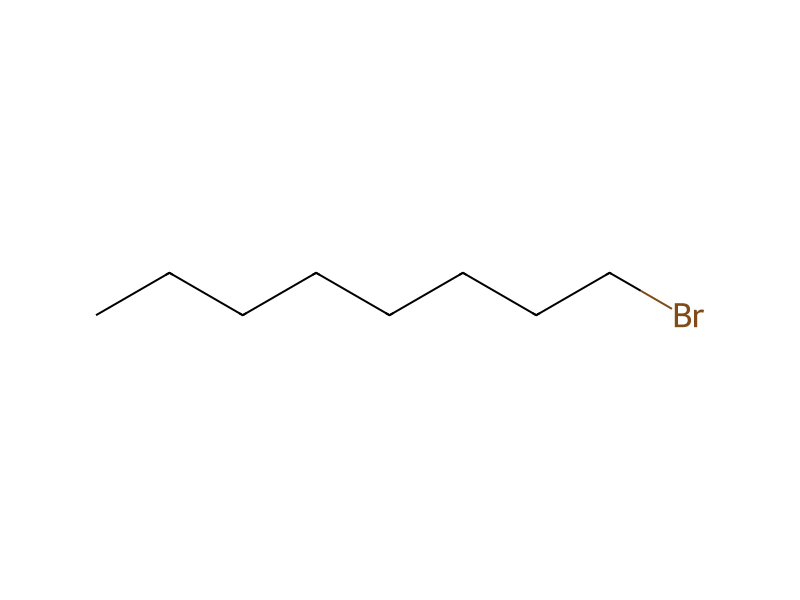
4-Hydroxybenzoic Acid → 4-(Octyloxy)benzoic acid
Reaction equation

[OH:1][C:2]1[CH:10]=[CH:9][C:5]([C:6]([OH:8])=[O:7])=[CH:4][CH:3]=1.CS(C)=O.[CH2:15](Br)[CH2:16][CH2:17][CH2:18][CH2:19][CH2:20][CH2:21][CH3:22].Cl>[OH-].[Na+]>[CH2:15]([O:1][C:2]1[CH:10]=[CH:9][C:5]([C:6]([OH:8])=[O:7])=[CH:4][CH:3]=1)[CH2:16][CH2:17][CH2:18][CH2:19][CH2:20][CH2:21][CH3:22]Participants
6
Reactant 4


Product 1

Reagents, catalysts & solvents 1

Procedure
A solution of p-hydroxybenzoic acid (19.2 g., 150 mmole) in 10% aqueous sodium hydroxide (120 ml.) is added to DMSO (480 ml.) previously heated to 80° C. n-Octyl bromide (28.95 g., 150 mmole) is added dropwise to the solution. The reaction mixture is stirred for 4 hours at room temperature after which it is poured into ice water (1200 ml.). Conc. hydrochloric acid (30 ml.) is added, and the mixture is allowed to stand until precipitation is complete. The precipitate is collected, dried, and crystallized from acetonitrile-water. m.p. 97°-99° C.
Workup
- additionis added dropwise to the solution
- customto stand until precipitation
- customThe precipitate is collected
- customdried
- customcrystallized from acetonitrile-water
Sources & evidence
- ORD record
- ord-216d950bb4254212bfa67eef21490697
- Source dataset
- uspto-grants-1981_10
- Patent number
- US04293486
Reaction notes
Loading…