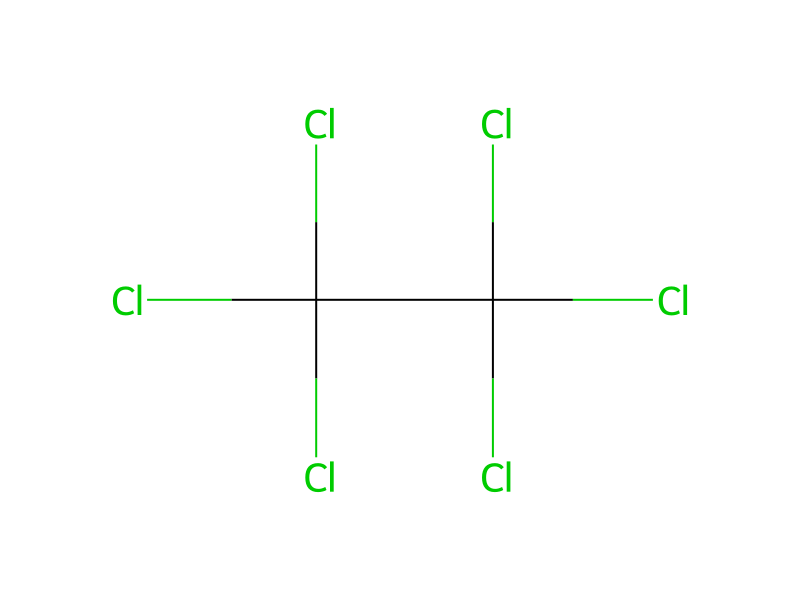
Hexachloroethane → 3-Chlorocaprolactam
Reaction equation

C([CH:8]1[CH2:15][CH2:14][CH2:13][CH2:12][NH:11][C:9]1=[O:10])(OC(C)(C)C)=O.[Li+].C[Si]([N-][Si](C)(C)C)(C)C.[Cl:26]C(Cl)(Cl)C(Cl)(Cl)Cl>C1COCC1.O1CCOCC1>[Cl:26][CH:15]1[CH2:14][CH2:13][CH2:12][NH:11][C:9](=[O:10])[CH2:8]1Participants
6
Reactant 3


Product 1

Reagents, catalysts & solvents 2


Conditions
- Temperature
- 0 °C
Procedure
Example 228 B) To a solution of 1 g (0.0047 mol) of this Boc-caprolactam product of Example 228 A in 10 mL of anhydrous THF at -78° C. was added 0.005 mol of LiHMDS. After stirring for 30 minutes, 1.2 g (0.005 mol) of hexachloroethane in 5 ml of anhydrous THF was added. The mixture was allowed to warm to 0° C. and was quenched with dilute HCl. The mixture was extracted with EtOAc and the organic layer was washed with 5% HCl, dried (MgSO4), filtered and concentrated to afford a yellow oil. The residue oil was dissolved in 40 mL of 1,4-dioxane (satd. with anhydrous HCl), stirred for 40 minutes, concentrated to afford 0.9 g of 3-chlorocaprolactam as an off-white solid.
Workup
- customwas quenched with dilute HCl
- extractionThe mixture was extracted with EtOAc
- washthe organic layer was washed with 5% HCl
- dry with materialdried (MgSO4)
- filtrationfiltered
- concentrationconcentrated
- customto afford a yellow oil
- stirringstirred for 40 minutes
- concentrationconcentrated
Sources & evidence
- ORD record
- ord-7dc4311919484ce9b2765bd063945009
- Source dataset
- uspto-grants-2000_01
- Patent number
- US06011028
Reaction notes
Loading…