Nicotinamide → 6-Aminonicotinamide
Reaction equation

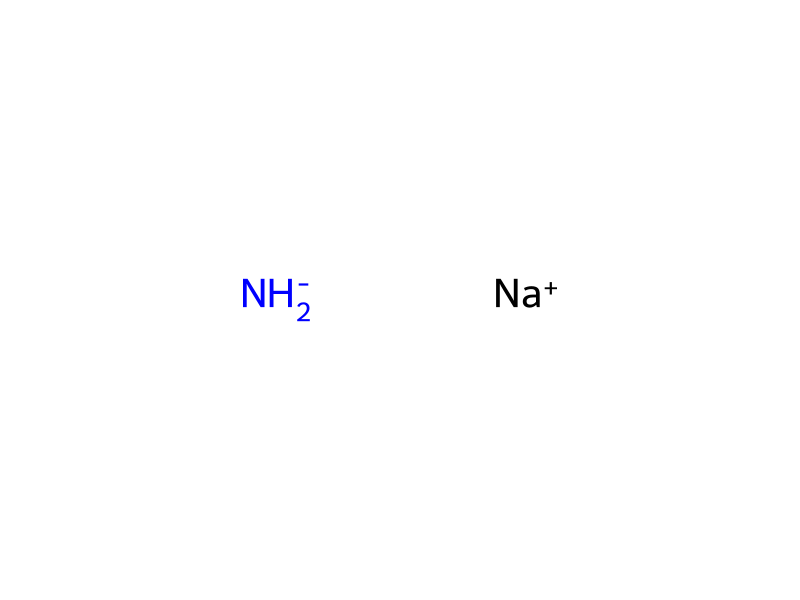
[NH2-:1].[Na+].C(O)(=O)CCCCCCC/C=C\CCCCCCCC.[C:23]([NH2:31])(=[O:30])[C:24]1[CH:29]=[CH:28][CH:27]=[N:26][CH:25]=1>C1(C)C(C)=CC=CC=1>[NH2:1][C:27]1[CH:28]=[CH:29][C:24]([C:23]([NH2:31])=[O:30])=[CH:25][N:26]=1Participants
Reactant 3


Product 1

Reagents, catalysts & solvents 1

Procedure
A mixture of 50.7 g (1.3 moles) of sodamide preformed in situ as in Example 1, 400 cc of xylene containing 0.1 cc of oleic acid and 73.3 g (0.6 mole) of nicotinamide was placed in an autoclave such as the one described in Example 2. The autoclave was closed and purged of air with ammonia. It was pressurized to 60 psig with ammonia and 200 psig with nitrogen. The pressure relief valve was set at 360 psig. The autoclave was heated to 122°-145° C. and maintained within this temperature range for 3 hours during which time hydrogen was evolved. The reaction mixture was cooled to room temperature and carefully hydrolyzed with 150 cc of water. Maximum temperature during hydrolysis was 18° C. The hydrolyzed mixture was filtered. The filter cake was washed with water and dried to give 14.3 g of 6-aminonicotinamide, m.p. 240°-247° C. The aqueous phase of the filtrate was separated and adjusted to pH 6.0 with concentrated hydrochloric acid. A precipitate formed which was filtered, washed with water and dried to give 5.4 g of 6-aminonicotinic acid, m.p. 314° C. with decomposition. The yield of 6-aminonicotinamide was 17.4% and the yield of 6-aminonicotinic acid was 6.5%. Both structures were confirmed by IR and NMR spectra. This result significantly differed from prior art references which report the classic Chichibabin amination product of nicotinamide to be exclusively 2-aminonicotinamide. Caldwell, Tyson and Lauer, J. Am. Chem. Soc., 66, 1479 (1944). Uses for the 6-aminonicotinic acid product of applicants' reaction were the same as stated in Example 4, whereas the recovered 6-aminonicotinamide was found effective as a rodenticide as reported in Johnson, Can. Pat. No. 1,089,763, for its inhibitory effect against Lactobacillus arabinosus as reported in Kitamura, et al., Yakugaku Zasshi, 95, 547 (1975).
Workup
- customThe autoclave was closed
- custompurged of air with ammonia
- temperatureThe autoclave was heated to 122°-145° C.
- temperaturemaintained within this temperature range for 3 hours during which time hydrogen
- customMaximum temperature during hydrolysis
- customwas 18° C
- filtrationThe hydrolyzed mixture was filtered
- washThe filter cake was washed with water
- customdried
Sources & evidence
- ORD record
- ord-96c82da5f31746beb88198c2f84edf7c
- Source dataset
- uspto-grants-1983_05
- Patent number
- US04386209
Reaction notes
Loading…