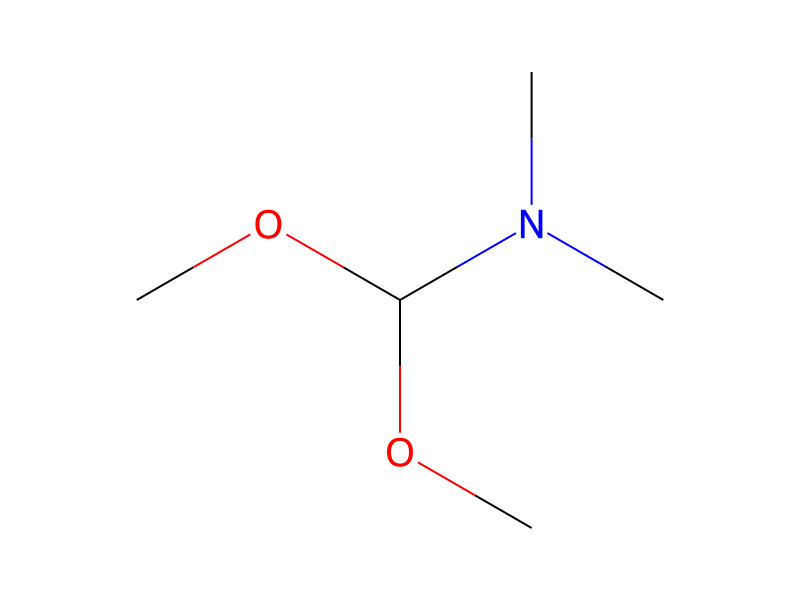
Dimethylformamide dimethyl acetal → (E)-methyl 4-(2-(dimethylamino)vinyl)-3,5-dinitrobenzoate
Reaction equation

[CH3:1][C:2]1[C:11]([N+:12]([O-:14])=[O:13])=[CH:10][C:5]([C:6]([O:8][CH3:9])=[O:7])=[CH:4][C:3]=1[N+:15]([O-:17])=[O:16].[CH3:18]O[CH:20](OC)[N:21]([CH3:23])[CH3:22]>CN(C=O)C>[CH3:18][CH2:9][O:8][CH2:6][CH3:5].[CH3:5][CH2:4][CH2:3][CH:2]([CH3:11])[CH3:1].[CH3:20][N:21]([CH3:23])/[CH:22]=[CH:1]/[C:2]1[C:11]([N+:12]([O-:14])=[O:13])=[CH:10][C:5]([C:6]([O:8][CH3:9])=[O:7])=[CH:4][C:3]=1[N+:15]([O-:17])=[O:16]Participants
5



Conditions
- Temperature
- 45 °C
Procedure
To a solution of methyl 4-methyl-3,5-dinitrobenzoate (D162) (20 g, 83.3 mmol, 1 equiv) in DMF (30 ml) was added N,N-dimethylformamide dimethylacetal (35 ml, excess) and the resulting solution was stirred at 45° C. for 30 min then cooled to room temperature and concentrated in vacuo. Trituration of the residue with Et2O/iso-hexane gave methyl 4-[(E)-2-(dimethylamino)ethenyl]-3,5-dinitrobenzoate (D200) (20 g, 81%) as a dark red solid which was used in the next step without further purification.
Workup
- temperaturethen cooled to room temperature
- concentrationconcentrated in vacuo
Sources & evidence
- ORD record
- ord-d395cd9147964bf7a16ad476fcd312c9
- Source dataset
- uspto-grants-2007_08
- Patent number
- US07253198B2
Reaction notes
Loading…