Triethylamine → N-(1-Azabicyclo[2.2.2]oct-3-yl)-4-iodo-3-nitrobenzamide
Reaction equation

Cl.Cl.[NH2:3][CH:4]1[CH:9]2[CH2:10][CH2:11][N:6]([CH2:7][CH2:8]2)[CH2:5]1.[I:12][C:13]1[CH:21]=[CH:20][C:16]([C:17](Cl)=[O:18])=[CH:15][C:14]=1[N+:22]([O-:24])=[O:23].C(N(CC)CC)C>CN(C=O)C>[N:6]12[CH2:11][CH2:10][CH:9]([CH2:8][CH2:7]1)[CH:4]([NH:3][C:17](=[O:18])[C:16]1[CH:20]=[CH:21][C:13]([I:12])=[C:14]([N+:22]([O-:24])=[O:23])[CH:15]=1)[CH2:5]2Participants
5




Procedure
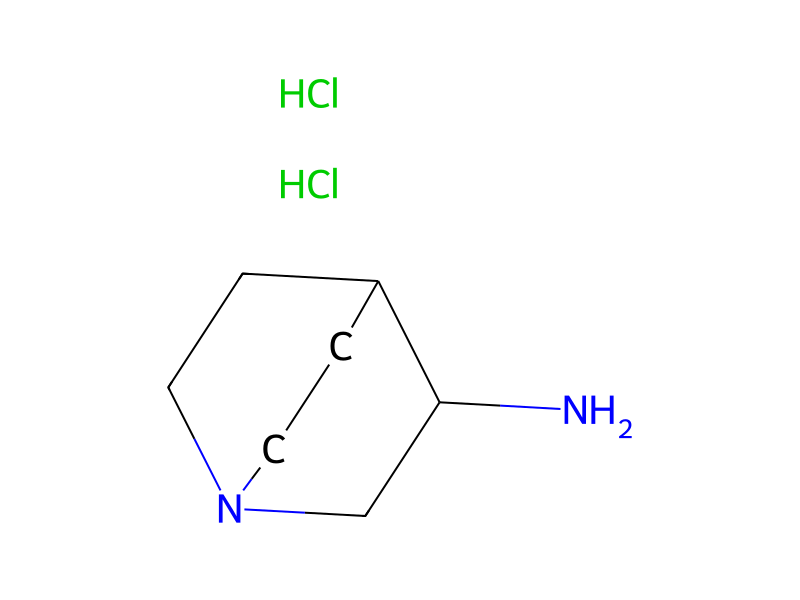
A solution of 3.08 g (24.4 mmol) of 3-aminoquinuclidine dihydrochloride, 7.60 g (24.4 mmol) of 4-iodo-3-nitrobenzoyl chloride, 9.88 g (97.6 mmol) of triethylamine in 150 ml of DMF was stirred at room temperature overnight. The solvent was distilled off in a rotary evaporator, the residue was taken up in 200 ml of dichloromethane, and 200 ml of a saturated sodium bicarbonate solution were added. The organic phase was dried over sodium sulfate, and the solvent was distilled off in vacuo. 2.20 g (22.5%) of the desired title compound were obtained.
Workup
- distillationThe solvent was distilled off in a rotary evaporator
- addition200 ml of a saturated sodium bicarbonate solution were added
- dry with materialThe organic phase was dried over sodium sulfate
- distillationthe solvent was distilled off in vacuo
Sources & evidence
- ORD record
- ord-19bae567823a440c9d3c24ed90770633
- Source dataset
- uspto-grants-2007_08
- Patent number
- US07256288B2
Reaction notes
Loading…